Writer-photographer Pat Blashill is a very old mate. We've been friends since 1989, after working together on some stories in New York for Melody Maker - he did the artist portraits and I wrote up the interviews. One of them was Sun Ra, would you believe!
Before he moved to New York, Pat was involved in Austin's punk-and-after scene, documenting the mayhem in real-time with his camera. That pictorial trove fed into his first bookTexas Is The Reason. Now Blashill has written the definitive history on the Texas punk and postpunk scene. Someday All The Adults Will Die! For which I was glad to offer this ringing endorsement:
"Texas had America’s wildest, weirdest punk-and-after scene – a primal playpen of shock rock, instinctive Dada, psychedelic freakout, performance art, scream therapy and absurdist anti-politics. Austin native Pat Blashill was in the thick of it, photographing the messy madness as it unfolded. In Some Day All The Adults Will Die!, Blashill shepherds the ultra-vivid memories of his contemporaries and threads through his own hindsight insights, forming an essential document thick with the textures of a long-gone real-gone time. Hilarious and poignant, this is a story never before told – and an inspiration to future free-thinkers and trouble-makers."
Published by the University of Texas Press, Someday All the Adults Will Die! is available here.
A mate of mine - a Matt of mine, even - Matthew Worley has a new and excellent book out in a week's time: Zerox Machine: Punk, Post-Punk and Fanzines in Britain, 1976–88. Via Reaktion Books.
Here's what I was happy to offer by way of an endorsement:
"Intensely
researched, teeming with insights and fresh connections, Matthew Worley’s book
is the definitive study of punk and postpunk fanzine culture. If you want to
know why zines mattered - why zines got people so excited - this is where you
should start”
So definitive and encompassing is Zerox Machine that there is a chapter towards the end in which Monitor is covered, with quotes from myself and David Stubbs.
Release rationale:
Zerox Machine is an immersive journey through the vibrant history of British punk and its associated fanzines from 1976 to 1988. Drawing on an extensive range of previously unpublished materials sourced from private collections across the UK, Matthew Worley describes and analyses this transformative era, providing an intimate glimpse into the hopes and anxieties that shaped a generation.
Far more than a showcase of covers, this book examines the fanzines themselves, offering a rich tapestry of first-hand accounts, personal stories and subcultural reflections. Through meticulous research and insightful analysis, Matthew Worley captures the spirit and essence of British youth culture, not only shedding new light on a pivotal movement in music history but crafting a unique alternative history of Britain in the 1970s and ’80s.
^^^^^^^^^^^^^^^
Another recent book of note is Switched On: The Dawn of Electronic Sound by Latin American Women.
Published by Contingent Sounds out of Berlin and co-edited by Luis Alvarado of Buh Records, a Peruvian label that specialises in reissuing Latin American avant-garde and experimental music, this book represents a double decentering of the received narrative about electronic music history: it focuses on the Latin American contribution, and further focuses on the role of female pioneers such as Beatriz Ferreyra, Graciela Castillo, Hilda Dianda, Jacqueline Nova, Jocy de Oliveira, and Nelly Moretto, among many others.
Release rationale:
"The official history of 20th-century avant-garde electronic music has been predominantly narrated from the point of view of Anglo-American and Western European experiences and largely remained focused on its male protagonists. To destabilize this history, this editorial project presents a collection of perspectives, essays, interviews, archival photos, and work reviews centered on the early electronic music production by Latin American female creators, who were active from the 1960s to the 1980s. The book also brings us closer to the work of a new generation of researchers who have focused on offering a non-canonical reading of the history of music and technology in Latin America. The publication is the record of a new vision, an account of the condition of being a woman in the field of music technology at a time when this was a predominantly masculine domain....
"The texts that make up this publication are organized spatially and conceptually, rather than following a chronology. The selection of female composers profiled sheds light on a variety of relevant aspects: key musical contexts, experiments with technologies (such as tape, electronic synthesis, the first commercial synthesizers), diverse formats (i.e., radio art, electroacoustic pieces, installation, multimedia, theater, film, etc.), intertwined with themes, such as migration, memory, identity, collaboration, interdisciplinarity, social engagement, the acceptance of electronic music, etc. Moreover, the framework of this editorial project opened a space for intergenerational dialogue and a meeting of aesthetics, as many of the authors gathered as collaborators are composers and sound artists themselves....
Edited by: Luis Alvarado and Alejandra Cárdenas
Composers and sound artists featured in this historical account include:
And it seems like almost every morning there comes the answer - yet more sad news
of another legend, who filled our lives with beauty and illumination, who's passed, and too often, passed earlier than we'd have expected.
Today’s sickening blow is Alan Rankine, who has died aged 64. Slightly older than
Terry Hall. Both were just four-five years older than me (how weird to think of
them creating these amazing records in their early twenties, recalling how barely-formed I was at that age).
Alan Rankine - gentle man and genius musician. I
had a lovely time interviewing him the couple of times we spoke. He was the music director and effectively more than half the backing band for one of the towering singers of our time, Billy Mackenzie,
someone else who left way too early. Not that he "backed" Billy: it was a partnership, a made-in-heaven musical marriage, a shared vision.
In particular, Alan was an inventive and
thrilling guitarist - an exemplary exponent of that clean, cold Scottish sound
that abounded at the turn of the Eighties - Skids, Scars, Josef K, Altered Images, Simple Minds et al.
The Associates! One of the sounds of our generation.
Sights
too- remember, ooh gosh,that swoony string of Associates appearances on Top
of the Pops in 1982. The mischief, the panache!
Remember, too, the record covers -what a handsome pair Alan and Billy made together.
RIP and condolences to family, friends, fans. To you and to me.
^^^^^^^^^^^^^^^^^^^^^
Here's some of the many opportunities I seized to write retrospectively about The Associates. There is also the chapter and a half in Rip It Up and Start Again, a tidied transcript of the first of those two conversations with Alan that appeared in Totally Wired, and the sleeve note for last summer's's deluxified reissue of Sulk, for which I spoke with Alan a second and, as it now turns out, final time.
I prefer this original wiry and emaciated-sounding single B-side version of "It's Better This Way" although the Sulk maximalist version certainly shows off Alan's potential to be a full-blown guitar hero
Once again, this time the studio version, for my absolute favorite "Skipping", or equal absolute favorite, alongside "Party", "Q", "White Car" and "No"
postscript
Roy Wilkinson has a very nice tribute to Alan Rankine on the Facebook Associates group, including a cool bit about "Party Fears Two" and this morsel, which made me want to listen to Alan's solo music:
I feel very fortunate to have done two in-person interviews with Alan. The first was in 1987, for Sounds magazine, talking about his second, post-Associates solo album She Loves Me Not. Alan was living in Brussels at the time. His first solo album, the impressive The World Begins To Look Her Age (precognitive title alert?), had been released on the Belgian label Les Disques du Crépuscule. In my mind, Alan was occupying a landscape established by one of The Associates richest concoctions, Skipping from their great album Sulk: “Ripping ropes from Belgian wharfs / Breathless Beauxillous griffin once removed seemed dwarfed.” (The Beauxillous griffin/griffon was a linguistic twist from dog-lover Billy – a spin on a Belgian breed, the Griffon Bruxellois). What I recall from this interview is Alan being very cool, handsome and quietly authoritative. I asked him if he missed anything about his native Scotland. He thought for a moment: “Just a pint of milk – in a bottle, full cream, a pint of milk you can drink in a one-er.”
From Roy's second Rankine interview, for Mojo, here's a nice bit on "Party Fears Two"
“Bill and I came up with [Party Fears Two] as far back as 1977. We were in Linlithgow, hungover, Sunday morning, one of the first things we did together. I came up with that lead keyboard line on the upright piano in the front room at my mum and dad’s. It’s just one of those special things that come from who knows where. It just happened. I never contrived to write that melody, it just happened. We both just looked at one another – like it’s really good. We didn’t record it [at that point]. We didn’t need to. Once you’d heard that could not forget it. But this was 1977 – punk. It just wasn’t right to emerge at that time, so we filed it away. Then we recorded a demo in a session in Willesden where we worked through the night. [At that point] it was called I Never Will, with different lyrics. Billy seemed to struggle for ages with the lyrics for a long time. It is a pretty unusual song. It starts in G major, but half way through the second bar of the intro it’s changed key. It changes from G into C then back into G again. Then, with the verse, it’s changing into B minor, then E minor. Then E major. It’s modulation but if you’d said to me that something was modulating that much in that short a space I would have said you’re crazy, but it just works. When that sort of thing’s working it’s when you’re not noticing it – Penny Lane by The Beatles modulates seven times…”
Rankine did a lot of producing while living in Belgium - people like Paul Haig and Anna Domino. This record with Tuxedomoon ally Winston Tong is said to be more like a full-blown collaboration than mere production.
My first guitar hero, at a time when the guitar hero wasn't really a thing. Keith Levene made unbelievable sounds with his instrument. Took the guitar to new places. So much beauty.
When I interviewed him in 2002, Keith said he thought "No Birds Do Sing" was PiL's peak - his best playing - and he could be right (it's always been a favorite). But there are so many peaks.
PiL counterfactual: if they'd done 9 other songs like this on the debut album, surely they'd have become instant stadium rock stars. There'd have been no need for U2! I'm glad they didn't take that path, but it's an intriguing thought - the group that came to destroy rock, make it obsolete, start their career with one of the greatest rock anthems of all time.
Along with the guitar god stuff, Keith was also quite nifty with a Prophet 5 synth.
Talking about Keith and keyboards, how about this almost-solo beauty? He could have done a whole album of this kind of thing and I'd have been very happy.
As PiL's de facto music director, Keith also made some great things without either guitar or synth (and with Wobble flown the coop too).
I don't think there's any guitar on this one either, so Keith's contribution is probably that beebling synth drone in the background and the EQ on the snares and hi-hats.
Can't miss this - "Death Disco" on Top of the Pops is one of a handful of turned-my-world-upside-down-inside-out moments of music on TV (others include "This Charming Man", "Party Fears 2", a T.Rex moment that shook me and that I've written about a couple of times now as a Primal Epiphany... and in a funny way the Rezillos on Top of the Pops singing a song about Top of the Pops)
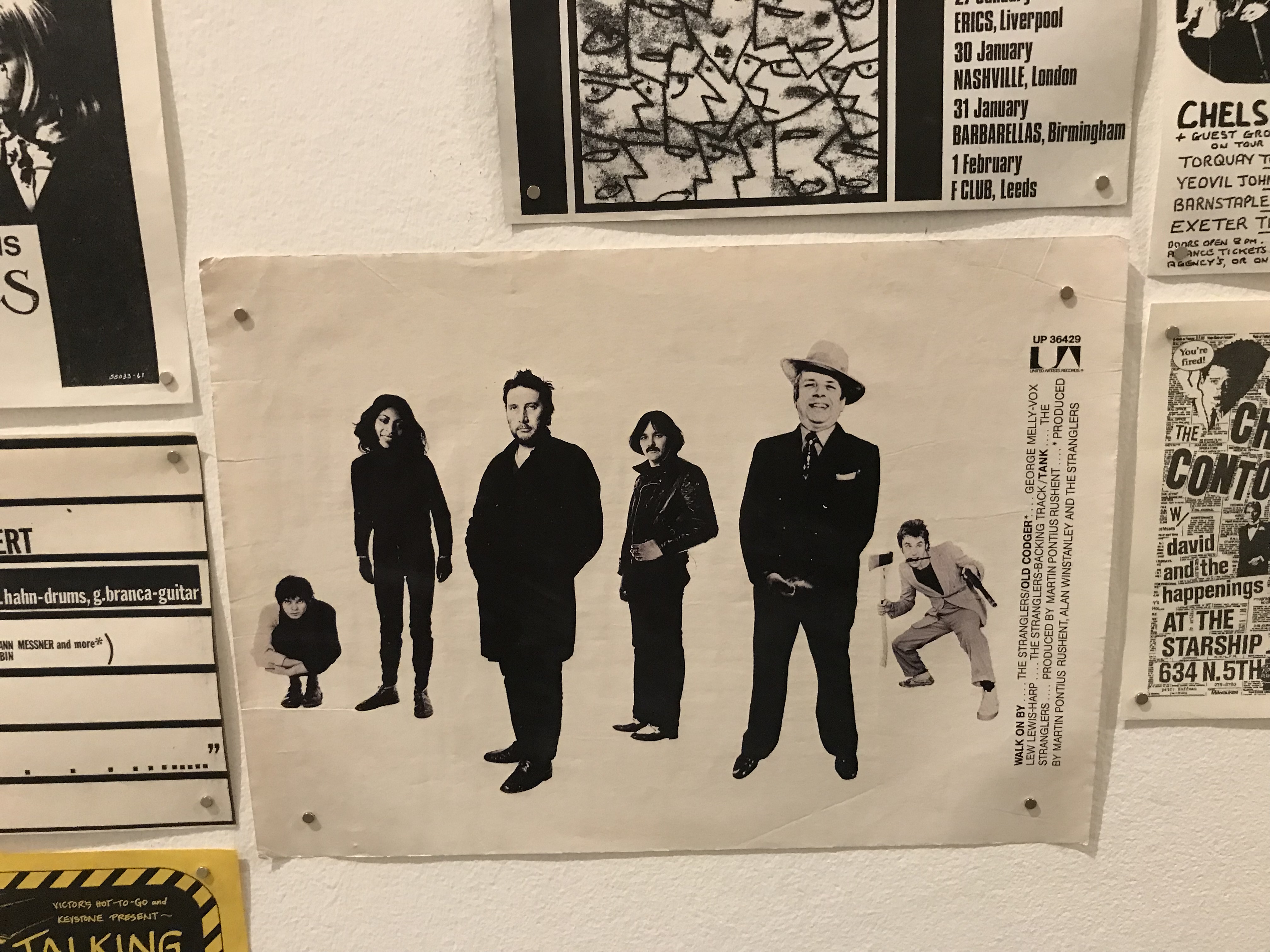
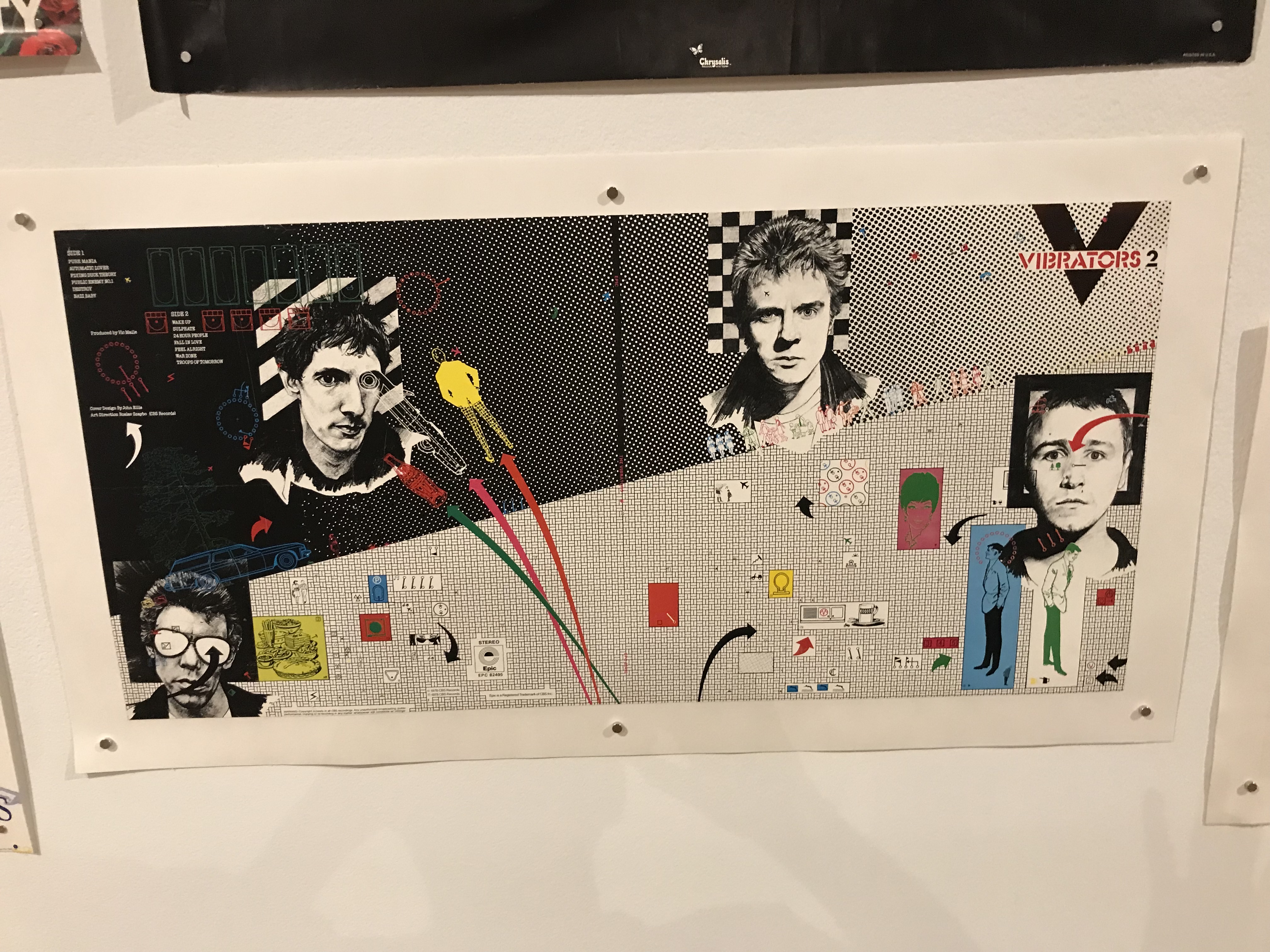
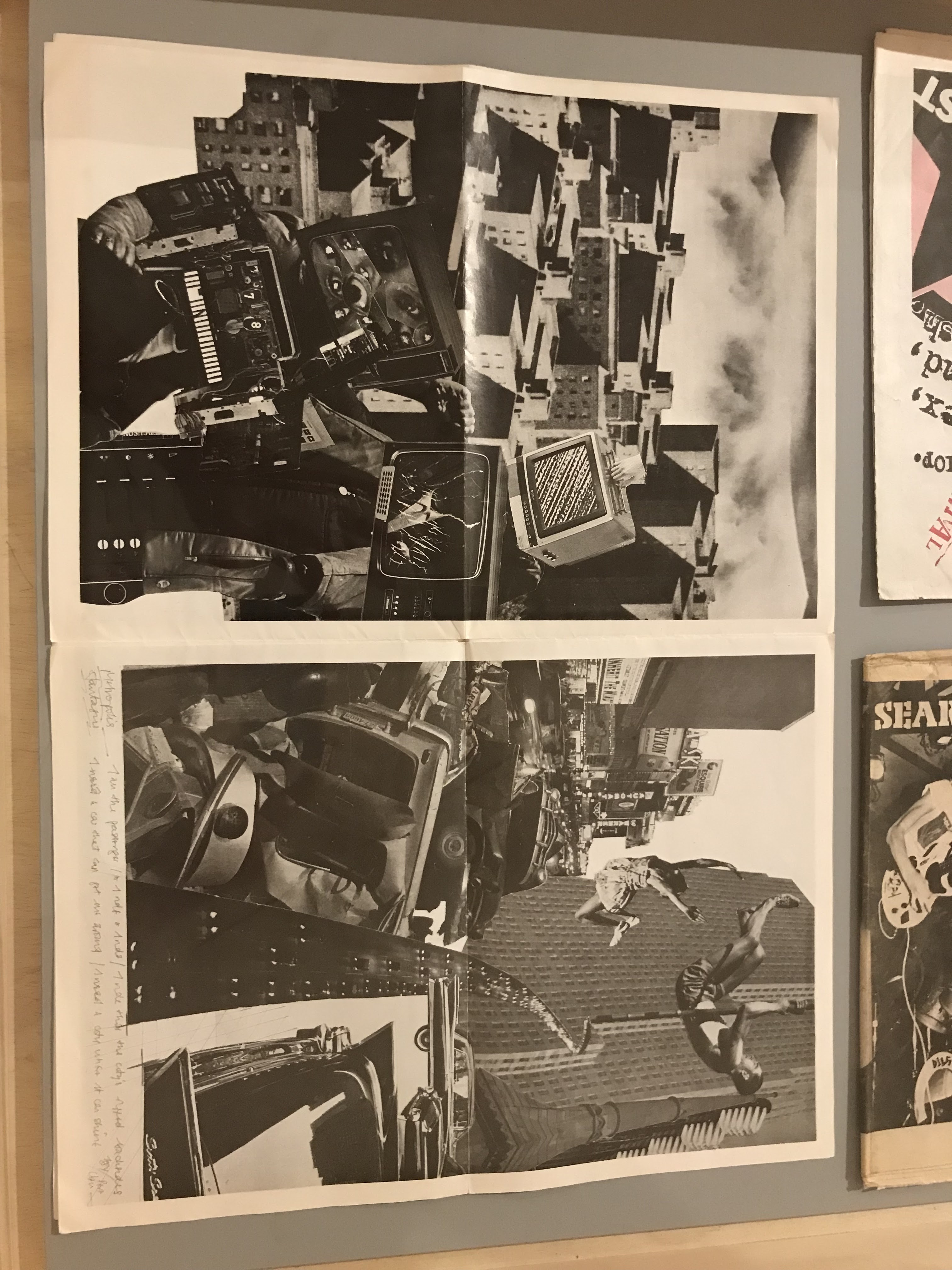
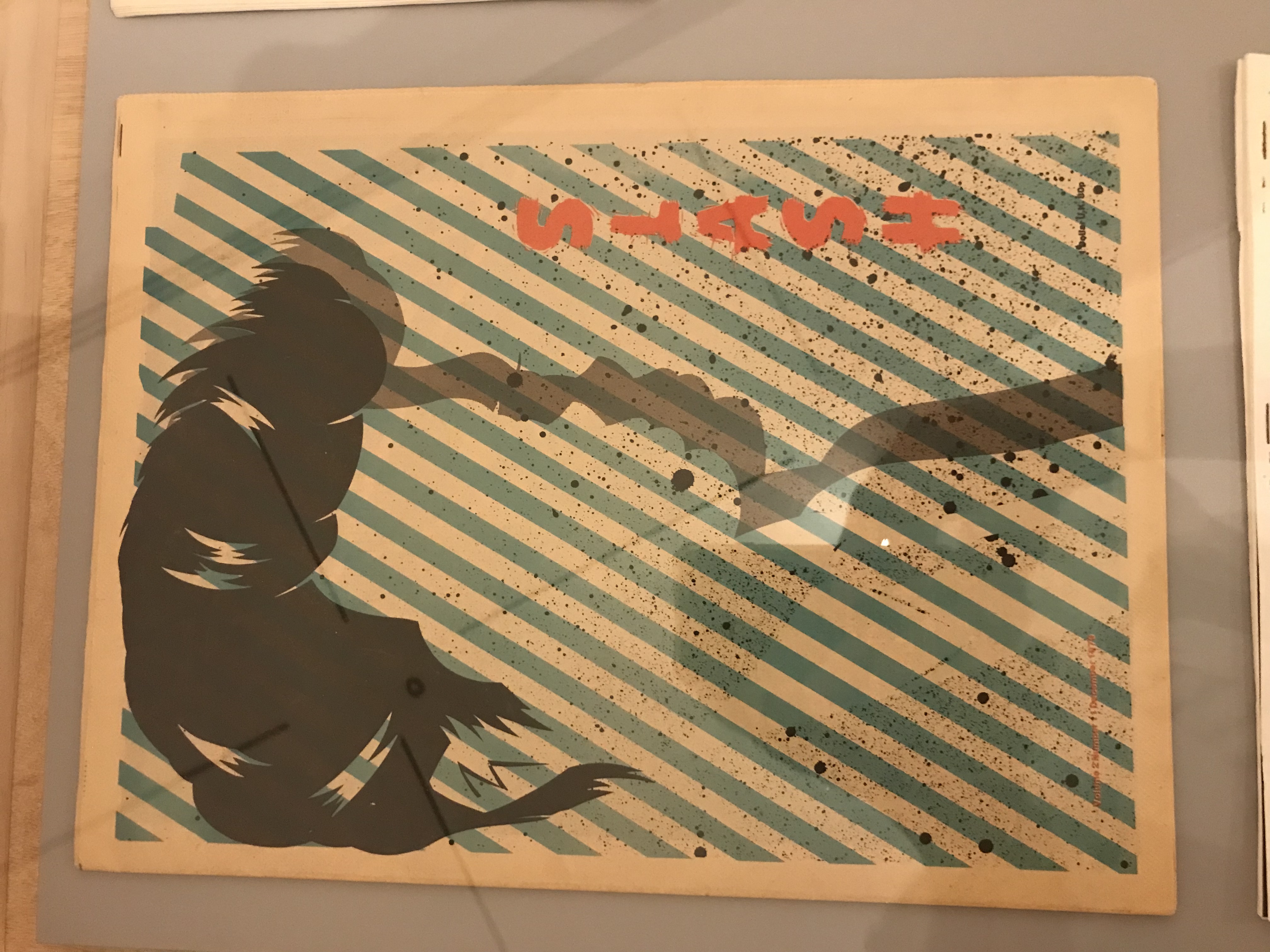
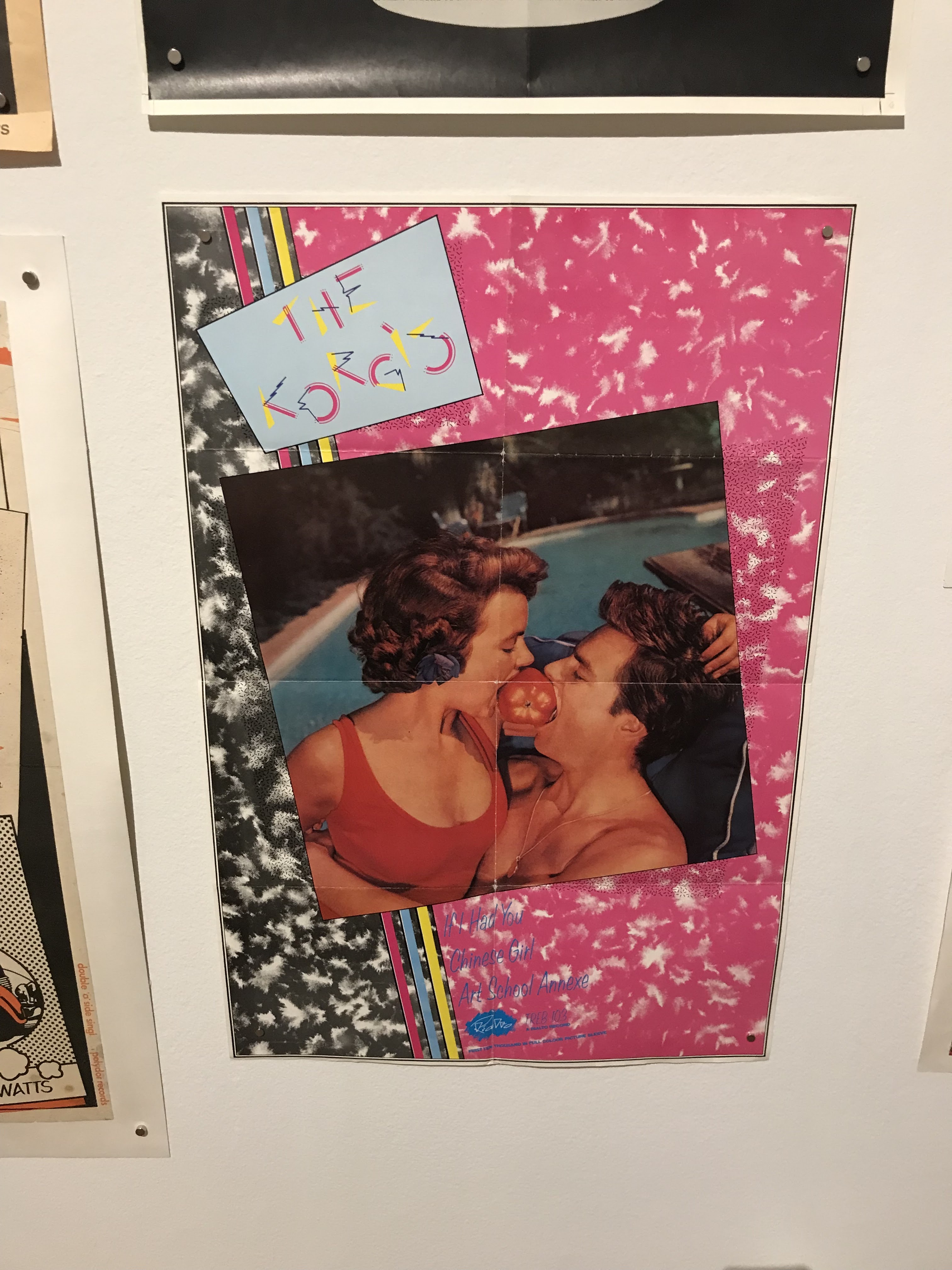
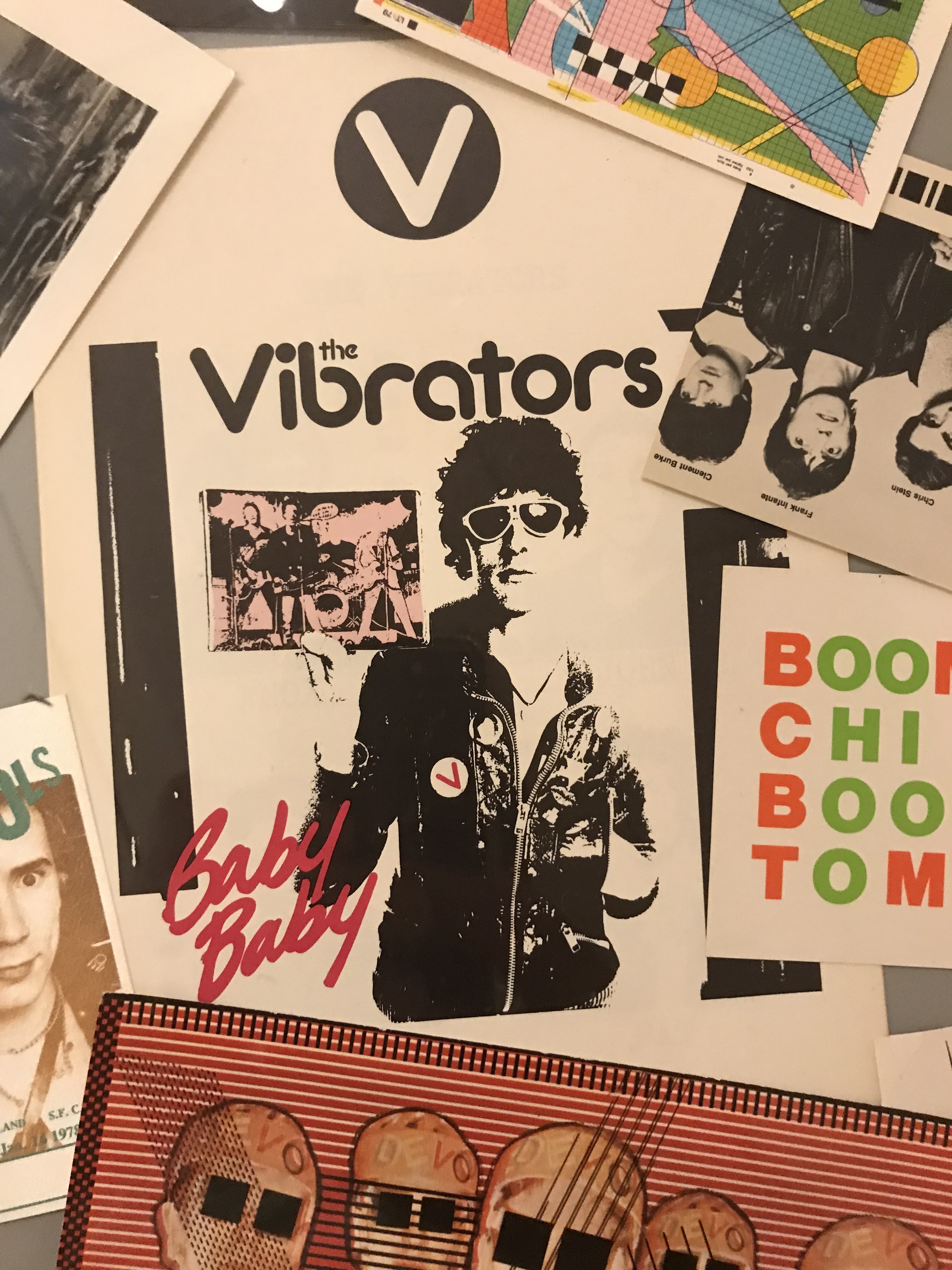
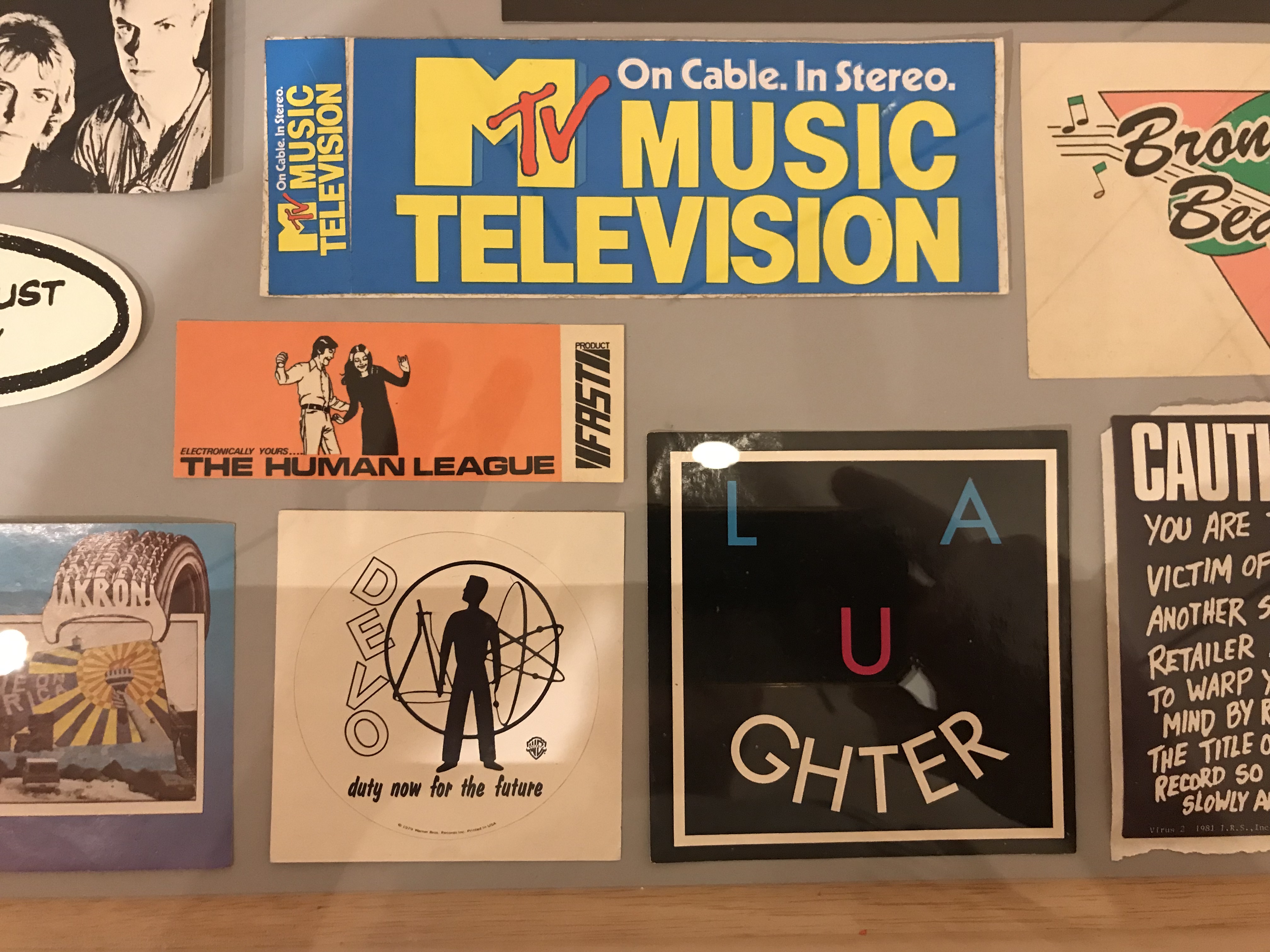
Torn Apartis an excellent exhibition of punk / New Wave / post-punk graphics - record covers, flyers, posters, advertisement, badges, zines, T-shirt, photographs - drawn from the collection of Andrew Krivine and curated by Michael Worthington. Torn Apart is now in its final days at the Pacific Design Center Gallery in Los Angeles and on the last night, Thursday this week, I'm giving a talk entitled A Different Kind of Tension: The Sound and the Look of New Wave. It's followed by a closing reception.
Date: Thursday 8th September
Time: 6pm
Admission: free
Address: PDC Design Gallery, 8687 Melrose Ave, West Hollywood, CA 90069
(In the absence of an AV projector, I was forced to perform the above album cover).
If you can't make the talk, then do pop by earlier in the week to look at the artwork - so many things I'd never seen before - and pick up the nifty free zine (see image at top of this blogpost) on offer in the foyer..


.JPG)