Showing posts sorted by relevance for query continuum. Sort by date Show all posts

Monday, April 27, 2009

YOU AND ME AND THE CONTINUUM *

I can't be at the Hardcore Continuum seminar at UEL this Wednesday (details here and
here; note that Martin Clark has since been added to the line-up). But I can be there in spirit with the following handy check list of misconceptions about the nuum, ideal for printing out as a card and consulting whenever you feel in danger of hearing, or indeed emitting, a fallacy.

fallacy #1: the nuum is a theory
It's something you can theorize about, certainly, but fundamentally it's an actually existing, empirically verifiable (and abundantly verified) thing-in-the-world, like jazz or reggae or folk or metal. "Continuum" is another way of saying tradition, which I prefer because "tradition" has that folksy/rootsy whiff about it and suggests an orientation towards conserving/preserving. "Continuum", more neutral in aura, suits a music culture that's temporally a two-way street, always simultaneously harking forward and vibrantly haunted by its past.

fallacy #2: the nuum is prescriptive
The misconception here is a mental image of a bouncer standing in front of a door barring admittance. How it actually works: new sounds emerge from the area of sound/culture/demographic under consideration, they have links to what came before, and what's interesting is to work out how strong the continuity is and what are the significant differences. Sometimes the links start to seem tenuous to the point where it feels like the music has branched off in another direction, perhaps ultimately to merge with other traditions/continuums. But this is descriptive as opposed to prescriptive.

fallacy #3: the nuum is parochial
Even quite sharp people have been heard to complain that the nuum concept doesn't "take into account" sound X from America, sound Y from Europe… But no one would say of an ethnomusicological study of cajun music that it was parochial for focusing primarily on Louisiana; no one would insist "hey, you should really factor in salsa to your analysis". The nuum is by definition UK-centric. To those who feel "left out," all I can say is: attend to your own continuums!

fallacy #4: the nuum = nineties
Grime and dubstep are indisputably extensions of UK garage, itself an extension of the nuum, its "Part 2". Grime and dubstep are undoubtedly phenomena of this decade (as are those other UKG offshoots bassline and funky). Yet strangely some of the same people who insist on grime and dubstep's continued vitality also like to maintain that the Nuum is a Nineties phenomenon. You can't have it both ways! Sure, the conditions within which music is made, distributed, discovered, consumed, etc, have changed a fair bit since 1992. But that makes the self-consistency of this strand of sound/subculture, its ability to change while remaining the same, all the more remarkable and intriguing.

^^^^^^^^^

There are other fallacies but this is enough to be going on with. One final observation: on Wednesday the phrase "UK bass music" will crop up quite frequently I expect. Bear in mind that "UK bass music" is just a colourless and contentless synonym for "hardcore continuum."


* "You and Me and the Continuum": a story by J.G. Ballard would you believe!

Monday, February 23, 2009


c/o FACT TV here's the podcast of my talk about the hardcore continuum plus onstage dialogue with Mark Fisher

^^^^^^^

the nub, or one of the nubs, here addressing counter-theories based around notions of deterritorialisation and unrootedness:

"I do try hard to be fair so I'm going to attempt to see why those theories and the artistic practice that accompanies them might appeal, where its element of idealism is. And I would say that it relates to a utopianism of space--that's really what makes it so 1990s, so early days of the web--the idea of connectivity, of postgeographical flows, of things that are remote being brought close, the separate and far-flung become one in the mix.

"Now the hardcore continuum operates through a different kind of utopianism, not constituted through space but through time. Oh, it does have a romance of place--the Just 4 U London thing. But I think time is the crucial axis. I always come back to this phrase I use a lot, the title of a track by a hardcore outfit called Phuture Assassins: "roots 'n' future". If you look at the hardcore continuum you can see a consistent impulse running through it that simultaneously casts backward to the past and forward to the unreachable horizon of the future.... It's like people in the scene having a heightened and highly charged sense of temporality... This utopianism of time is something that threads through the culture in strange loops because when you listen, as a fan, to stuff from all across its breadth and length, you get these uncanny timewarp sensations--you hear things in 1990 bleep tune that are future-ghosts of sounds in grime or dubstep or bassline. It's almost like any track from any point in the continuum contains all the past and all the future of this music inside it. Like DNA or something."

^^^^^^^

Talking of time, for those who don't have a spare 1 hr 52 mins, later in the week I'm going to be putting the text of the talk up here (or maybe here as it's a bit um long) plus preprepared riffs addressing various points, which i'd meant to use during the dialogue part but time ran out

Wednesday, September 30, 2009

A new online publication: Dancecult: the Journal of Electronic Dance Music Culture
http://dj.dancecult.net/index.php/journal

Lots of interesting looking articles, but of special interest to parishioners, two reports on the UEL Hardcore Continuum symposium, by Jeremy Gilbert and Mark Fisher

Re. Mark's points about the abstract reality of the hardcore continuum:

I think one place to look where this seeming empirical/theoretical clash is resolved is in History. They are plenty of examples of material/social phenomena that are real and concrete but are not necessarily consciously apprehended in their systemic totality by the subjects who constitute and sustain them. Imperialism might be one example, although in that case words like "empire" and "imperial" were used by both the dominators and dominated. A better analogy for the HCC would be what historians used to call feudalism but is now known more precisely as manorialism (a/k/a serfdom). With manorialism, I don't think people inside that system necessarily went around thinking of it as a system, but just as the ways thing were done, in the same way that it's unlikely that any peasant declared, a la Monty Python and the Holy Grail, "Now we see the violence inherent in the system!". But that doesn't mean that the systemic-ness wasn't there, or that there wasn't violence inherent in the etc etc. Manorialism/serfdom is a specialist term, conceived retrospectively, and never used by the actual inhabitants of what it describes; but that system (relations of fealty, property rights, division of land, farming methods, inheritance customs, etc) existed as both an abstract structure and a lived reality. It evolved through time, rising and declining; it co-existed with other kinds of socio-economic activity, like the guild system and merchant trade, which evolved into the early forms of capitalism, gradually eclipsing the manorial system but not extinguishing it for a long time, indeed the latter lingered long, long after its prime. The analogy here would be the HCC's coexistence with emerging delocalised and web-enabled forms of music culture which look set to eclipse its own particular system, which increasingly seems like an aberration, something swimming against the tide of the Nineties.

What is the systemic core of the nuum then? It's a particular set of relations based around pirate radio, dubplates, raves and rave-style clubs, along with certain kinds of music-making technology, also various customs and rituals. I've argued that the nuum is a UK adaption of the Jamaican system. Instead of sound systems mutating into raves or clubs (the obvious adaption, you might have thought), I think what happened was that pirate radio stations took the place of sound systems: they were sounds on the air. Another major UK mutation of the Jamaican approach was with dubplates. In Jamaica and in the direct UK transplant of the Jamaican approach in the form of UK reggae systems, dubplates specials were the unique property of a single sound system. In the UK hardcore raves scene, a more complicated system developed because of the guest DJ circuit that sprang up from the late Eighties onwards as a result of house music. That meant that deejays, instead of being tied to a sound system or a club residency, became independent operators playing at different raves and clubs. Dubplates then became a kind of patronage system or symbiotic exchange relationship between a DJ and a loose stable of producers. Sometimes, with a really powerful deejay, that becomes an exclusive relationship (Grooverider's boys would give only him their tracks; he would choose which ones out of many offered to make up as dubplates). Sometimes it would be semi-exclusive (a name producer giving dubs to a select group of deejays). And you had DJs who were producers themselves and cut dubs of their own music. This particular system is eroding as terrestrial broadcast pirate radio wanes in importance, while DJs increasingly move to digital formats and make a name for themselves with give-away mixes on the web. Similar to the emergence of merchant trade and early capitalism in parallel with a waning feudalism, you can see a new system, fully integrated with the web, eclipsing the older one.

If you only consider this music in terms of sonics, its genre characteristics, rather than as an element within a socioeconomic system, the dimension of continuity becomes fuzzier. You might hear its proximity at certain point to other sounds and imagine that there's a link there, when in practical terms--as scene rather than genre--these are two distinct subcultures. A good example of this is Big Beat. A genre I happen to like a lot. In its prime, it produced some fantastic records and some of the best dancing nights of my life. Now Big Beat actually had some resemblances to hardcore: the collision of hip hop and house, the riffy-ness, the hell-for-leather drugginess. But from a historical perspective, there is very little link between Big Beat and the hardcore continuum. All those people like Chemical Brothers and Fatboy Slim came out of the Balearic/Madchester/indie-dance lineage. Big Beat was organized around a completely different systemic infrastructure to the nuum. There were no Big Beat pirate stations. Big Beat was much more intimately connected with the mainstream record industry, there were relationships to certain major-league indie-rock bands (which as Britpop took off became the biggest rock bands in the land), there was the connection with the power nexus of Heavenly (the label/publicity/management organization), and so forth. It was based around a different circuit of clubs and had a markedly different audience composition.

Now, as I say, I have great affection for Big Beat as a moment, so it's no slight to say it has little to do with the nuum (even though later on you had a breakbeat-y strain of garage was that was oddly close to big beat, sonically). But equally, as fond as I am of the records, I would have to say that the reason that Big Beat didn't lead to anything (in terms of subsequent genres or a legacy beyond itself) has everything to do with it's not being based around as radical and fertile a systemic structure as the econo-cultural engine that sustained and--even now--sustains hardcore/jungle/UKG/grime/dubstep/funky.

I suggested that the inhabitants of the HCC are unconscious of it. Well, they don't use the term, and probably that's for the better! But it seems to me they are actually perfectly aware of what they're participating in, as indicated by quotes like this one from Geeneus in the much-discussed XLR8 piece on (cough) "funkstep":

Things come back around, and even though funky is called funky, really you could say it's not that much different from garage. It's just another full circle. With America, hip-hop is hip-hop, and even though the music changes and new sounds and people come into it, the flow remains hip-hop. But in the U.K., as soon as something new comes along, it’s like, “Oh, that's new music—let's call it a new name!” when really, it's all the same thing. We just progress along. So I'm doing funky, Skream's doing dubstep, Wiley's doing grime, but we're all together. We're all on the same radio station, we all come from the same place, and we've all got the same influences. It's really all part of the same continual flow.

That's the horse's mouth.

Wednesday, March 04, 2009

Two upcoming events for the London massive!


Ghost Box and Trunk Records
present

BELBURY YOUTH CLUB NIGHT

Wednesday, March 11, 2009 at 6:00pm to midnight
Location: Shunt Lounge, 20 Stainer St. London
Information: Email: contact@ghostbox.co.uk / www.shunt.co.uk

DJs: Julian House & Jim Jupp (Ghost Box), Woebot, Mark Pilkington (Strange Attractor), and Jonny Trunk.

James Cargill and Trish Keenan of Broadcast provide a live improvised soundtrack to a short film by Julian House.

Throughout the evening we'll be screening a programme of rare, unsettling and forgotten TV drama and public information films.

^^^^^^^^^

Sadly I won't be able to attend :(


^^^^^^^^^

and how about this?


THE HARDCORE CONTINUUM? A DISCUSSION

Presented by the Centre for Cultural Studies Research, University of East London
In association with The Wire
Location: UEL Docklands Campus (Cyprus DLR, Zone 6)
Time/date: April 29th 2009 2:00pm-6:00pm

Simon Reynolds's commentary on the "hardcore continuum" - the mutating sequence of dancefloor music to have emerged from the breakbeat hardcore matrix of the early
1990s has recently generated intense debate in the musical blogosphere.

What is the value of this concept? Does it still usefully describe the context from which dynamic new beat musics emerge? Can the conditions of creativity in the 1990s be replicated in the era of web 2.0? Should we even want them to be?

Speakers: Mark Fisher (K-Punk), Alex Williams (Splintering Bone Ashes), Steve Goodman (Kode 9), Lisa Blanning (The Wire), Dan Hancox (Guardian, New Statesman), Kodwo Eshun (Author of More Brilliant than the Sun), Joe Muggs (Mixmag, The Wire), Jeremy Gilbert (Co-author of Discographies)

Attendance is free but pre-registration is recommended. For info or to register contact J.Gilbert@uel.ac.uk

^^^^^^^^^^^^

Sadly I won't be able to attend :(

(Not that I was invited)

Friday, February 20, 2009

PUT A WONK ON IT

And I suppose my reaction is: what of it?

That's not a reaction to the music per se, which makes for perfectly absorbing listening. The Joker Purple Wow mix and the Vex'd Sundaywalkmanmix both get the thumbs-up from my chairbound ears; the Zomby EP at its best is like Isolee-goes-dubstep. Listening I can't quite imagine real bodies moving in real space (to borrow a phrase) to this music though. At its most writhingly omnivorous and deliquescent (the Vex'd mix, "Aquafresh" ) it would seem to require the kind of moves you associate with avant-garde ballet ensembles; elsewhere the vibe is more headnodding and stoner-y (Purple Wow). But putting its attractions and applications aside for a moment, what does the existence of Wonky prove vis-à-vis the Hardcore Continuum? The fact that a bunch of producers are making music that draws on some Nuum elements but adds influences from elsewhere? That does appear to be what a lot of the pro arguments boil down to: it don't just borrow from the Nuum, it borrows from all over. But that's happened before (sometimes excellently: Luke Vibert; sometimes not so…) and will happen again. It's perfectly possible and quite likely that Wonky will establish its own autonomous significance without having the slightest impact on the Nuum (which will flourish or wither for its own internally-driven reasons).

Wonky does have a vestigial link to the Nuum, of course, in so far as it's a name somebody [Martin Clark in fact] came up with to describe five or six producers on the periphery of dubstep who became increasingly (and understandably) bored with its constraints and accordingly worked in other flavours and feels: crunk, G-funk, Eighties videogame muzik, J Dilla/Flying Lotus kosmi-hop… Sometimes it sounds a bit like how you always hoped hyphy would; sometimes it recalls Schematic acts like Phoenicia but even more bendy-limbed, double-jointed and superlubed; sometimes it has the same relation to Ruff Sqwad that Squarepusher had to Remarc; sometimes it's like John Carpenter jamming with Zapp; sometimes it's almost like trip hop but with an Eighties digi-synth rather than Seventies analogue sound-palette. Today for all kinds of technological reasons it's more easy than ever to be polymorphously magpie-like. But it was never that difficult, which is why you had people making similar eclectronic moves from the mid-Nineties onwards, albeit with different sets of reference points.

Wonky is situated structurally in a similar place to breakcore, drill'n'bass, illbient. It's the latest in a(dis)continuum of post-everything genres. Or perhaps that should be genre-not-genres, since the definition of a genre depends as much on what's left out as what's included. Breakcore, drill'n'bass, illbient, all occupied the space-between, the peripheral hinterland surrounding the established genres, which are stable (yet evolving) and distinct (yet porous, allowing new influences in it). Now if you've read Energy Flash and specifically the chapter on art-tekno (what would later be called IDM), you'll understand my skepticism about the post-everything interzone--the feeling that this is a weak place from which to make music if you are looking to have any kind of cultural repercussions. Oh, good sounds can come out of it but…. Does anyone listen to the illbient records now? Are they talked about? The Nuum, though, has literally thousands of tracks up on Youtube. A vast tranche of discourse trailing behind it, of which the stuff that actually refers to the concept of the Nuum is just a thread.

I think this relates to the greater motivating and mobilizing power of the Nuum in all its phases (see also: equivalents in other areas of dance music, like gabba… or other sorts of music altogether, such as hip hop, or metal, or reggae…). There is something about the Nuum sounds that inspires fervor. The feverish generation of histories and theories (or rather the activation of theories that are latent and immanent within the music itself). And the Nuum catalyses not just theorisation but a testifying discourse.

This is related to the intrinsic power of the music in all its successive stages, for sure, but also I think to its being grounded: socially, geographically, in terms of material infrastructure. A music whose demographic is the hyper-hipsterati (hipsters sharp enough to disdain the stereotypical hipster), a music whose infrastructure consists primarily of the web* ... could that really have sufficient tenacity to stick around, to not be blown hither and thither by the winds of fashion? Music molded entirely according to the logic of online culture--drifting, distraction, intertextuality run rife, the additive logic of audio-greed (I'll 'ave that, and that, and that, and…). It might end up sounding how Buggy G. Riphead artwork looks**.

* For sure, grime uses the web much more than it did even four years ago. But (Martin Clark tells me) the "road" audience for grime and for funky still primarily look to the pirates, for terrestrial broadcasts in real-time (partly because that's compatible with in-car listening). In other words, they are still "locked on". When they cease to be…

** One of the emerging lines on Wonky is the shades-of-FSOL argument that it works by loosening up the strictures of the established genres, which are staid and monochrome. Alex Splintering's take seems to me a theoretically sophisticated and vividly phrased version of that e.g. it's not a genre it's a process (of wonkification)applied to various styles. Now dubstep could certainly use some wonkification, some irrigating colour-juice. But I'm generally suspicious of this kind of talk because it seems to imply that Nuum genres are constrained and restrained. But a huge aspect of Nuum music in all its phases is precisely that it sounds out of proportion, lopsided, de trop. Darkside is the paragon example of this wrongness-as-rightness. But let's take more recent examples: what could be more aberrant than Wiley's beats on "Ice Rink" or pretty much any Terror Danjah groove? And then there's bassline, whose arpeggiated B-lines are garish, rococo, ludicrously lubricious, obscene in their Rabelaisian ripples of flatulence. Nuum music has never been afraid to be daft. You might say it is always already wonky.

^^^^^^^^^^

What is going on that the three ukdance genres of 2008-09 (almost) rhyme: wonky, funky, donk(y)?!?!

Wednesday, January 28, 2009


On February 11 I'm going to be in Liverpool to give a talk on the Hardcore Continuum hosted by FACT (Foundation for Art and Creative Technology), in association with The Wire. There'll be an audio-visual component (expect: rude 'n' cheesy) and the main body of the talk will be followed by an onstage discussion with Mark Fisher (Acting Deputy Editor of The Wire/K-punk) and then a Q/A session with the audience.

Location: FACT, 88 Wood Street, Liverpool, L14DQ
Date: Wednesday February 11th
Time: 7.00pm to 9-00 pm
Admission: £7.00/£5.00 (members & concessions)
Information: tel. 0151 7074444 or http://www.fact.co.uk/


In parallel with the FACT lecture and as part of the magazine's 300th Issue commemorative program of online selections from its voluminous archives, The Wire presents my series of hardcore continuum articles: seven essays, midway between scene reports and thinkpieces, that appeared in the magazine between 1992 and 2005, documenting in real-time the paradigm shifts from rave to jungle, UK garage to grime.


Here's my introduction to the series archive
and
here's the first piece, on Ardkore and "Rush Culture", from November 1992
and
here's the second one, about Ambient Jungle, from that glorious summer of 1994
and
here's the third one, on The State of Drum & Bass, June 1995
and
here's the fourth one , Slipping Into Darkness, about Jump Up and Techstep, June 1996
and
here's the fifth one , Neurofunk Versus Speed Garage, December 1997
and
here's the sixth one, Adult Hardcore a/k/a Feminine Pressure, about 2step Garage, from April 1999 -- plus the infamously long footnotes to the piece originally on the Blissout website
and
the seventh one, on Grime (and a little bit of Dubstep), published April 2005


Once the whole set of pieces is up, I'm going to scribble down here some of my more straggly and whimsical afterthoughts/memories relating to this series, which after all constitutes, in a funny, veiled sort of way, a kind of autobiography.

Thursday, July 17, 2025

"mapping the brainrot continuum"

Hasten to read - while the paywall is relaxed for 24 hours - this fascinating conversation between Kieran Press-Reynolds and Shawn Reynaldo (no relation) for the latter's substack First Floor. Kieran talks about being a Gen Z writer about music + memes + internet subcultures - or as Reynaldo puts it, "mapping the brainrot continuum". 

There's also some glimpses into Press-Reynolds family life. 

E.g. 

"I think I always wanted to be a writer. When I was six, I made my own newspaper. But I also had that teenage rebellion thing where I thought that what my parents did was the lamest thing ever. I’d come home from school and my dad would be playing weird ambient alien sounds, and I’d think, 'I just want to go play Minecraft. Turn this off.' Then my mom would come home and she was exhausted every day from work. Both of my parents were like, 'This is the worst job. Do not follow in our footsteps'."

I must say I don't remember ever saying it was "the worst job", being a critic - after all, it's got a lot of upsides. 

But we did kind of hope he would choose a path that didn't lead to precarity. 

And we really didn't expect him to go down that same path. As a teenager he showed no interest at all. I always thought Kieran would do something involving video. Or invent an app.

But he's joined us in the incredible shrinking field. 

Monday, March 16, 2020

stuff to read while cooped up for the foreseeable

For starters - a piece by my son Kieran Press-Reynolds on how TikTok is changing pop and the rise of no-melody rap

A little thing I did for Tidal on David Bowie's second album Space Oddity, which they now have up there in "360 Reality Audio"

Stuff to read and stuff to listen to too - for here's a radio show / podcast about The Sex Revolts - which is about to come out in Germany for the first time - produced and hosted by Klaus Walter, featuring interviews with me and Joy Press.

Quite a family affair, this blogpost!

Outside the immediate clan, here's some things worth a peruse:

From a few weeks ago, an interesting piece by Chal Ravens about a sound that has emerged in recent years on the UK club scene based in a transnational eclecticism that coheres through its vibe (percussive, jolting, lots of flashy deejay tricks) and by its relative lack of relationship to either the sound system / hardcore  continuum lineage or to 4/4 house / techno (it'll use elements from both here and there, but the groove feel is different - drawing more on gqom, Jersey club, etc).

major points: 


"sideways not forwards" is the axis on which this music moves i.e. it doesn't have a romance of the future, it has a romance of the exotic

"It’s music to stay on top of rather than music to get lost in" (a sharp description of how the juddering beats put you on edge, you don't trance out)

But unlike it's sort-of precursor deconstructed club, it's very much banging, slamming, hedonistic, exuberant, physical


Enjoyed also Chal's swipe at "the fusty-seeming legacy of the hardcore continuum," something the      nu-generation producers in the UK are keen to leave behind 

If there's a philosophical wrinkle in the project, it's the fact that the style is dependent on the kind of regional sounds that the UK itself is not able to generate anymore - all those African or US-city based genres it draws from


Another interesting piece is this one by Ryan Alexander Diduck (author of Mad Skills: Music and Technology in the 20th Century) in which he attempts to identify what sonically defined the 2010s.  Starting with the observation that "the sound of the decade was … processed...  The electrical signal of almost every recording...  was to some extent rendered synthetic. Pop music of the 2010s was dripping wet with all manner of effects, plug-ins, pitch correction, equalization, delay, reverb, time manipulation... " Diduck suggests that although Auto-Tune is the most well-known and ubiquitous form of this plastic-fantastication of pop, side-chain compression was "equally omnipresent," if less easily apprehended by the layperson listener.  You're hearing it constantly, but you don't necessarily know that you're hearing it.  Diduck further argues that side-chain compression constitutes not just a recording technique (squeezing "the volume of a.... specific instrument or track [let’s say, the bass guitar] to the input of another instrument or track [say, the kick drum]") but that it carries with it and imbues a techno-politics. "Technologies enact, technically, analogous cultural logics.... [they] act out our shared understandings and expectations about how things could or should be in the world." 


The argument is quite intricate, but the gist is that sidechain compression represents a kind of regulation of noise, allowing for disruption but channeling and constraining it. "Each time any sound too aggressively enters into the sonic field, other sounds drop out to absorb the potential trauma of a distorted signal."  This happens automatically. "Side-chain compression can therefore be read as a kind of sonic risk management system" - one that parallels the "algorithmic, artificially intelligent, and ideally automated functioning of global capitalism. Our system is built to absorb, redistribute and even to foresee shocks of all stripes: economic, political, social, environmental..."

Towards the end, Diduck - writing some weeks ago, before the current crisis - wonders whether there could be a "a shock that cannot be conceived, much less compressed, yet to come?" Well, events overtake: it could be that it is now upon us, a catastrophic shock to the system that can't be assimilated, absorbed, and turned to profit....  an abyss of pure loss.  

(Incidentally, Diduck starts the piece referring to my series of end-of-decade pieces on conceptronica, the resurgence of ambient and new age, and streaming in music and TV' , which he describes as "each more contentious than the last". [He missed one, though - the feature on trap and its globalisation].  Weird -  I don't feel there's anything hugely contentious about any of those pieces - I mean, they each have an argument, but they're hardly inflammatory or willfully contrarian. If people's tolerance for "opinionated" has weakened that much.... ooer missus)

Friday, August 19, 2022

le hardcore ne mourra jamais


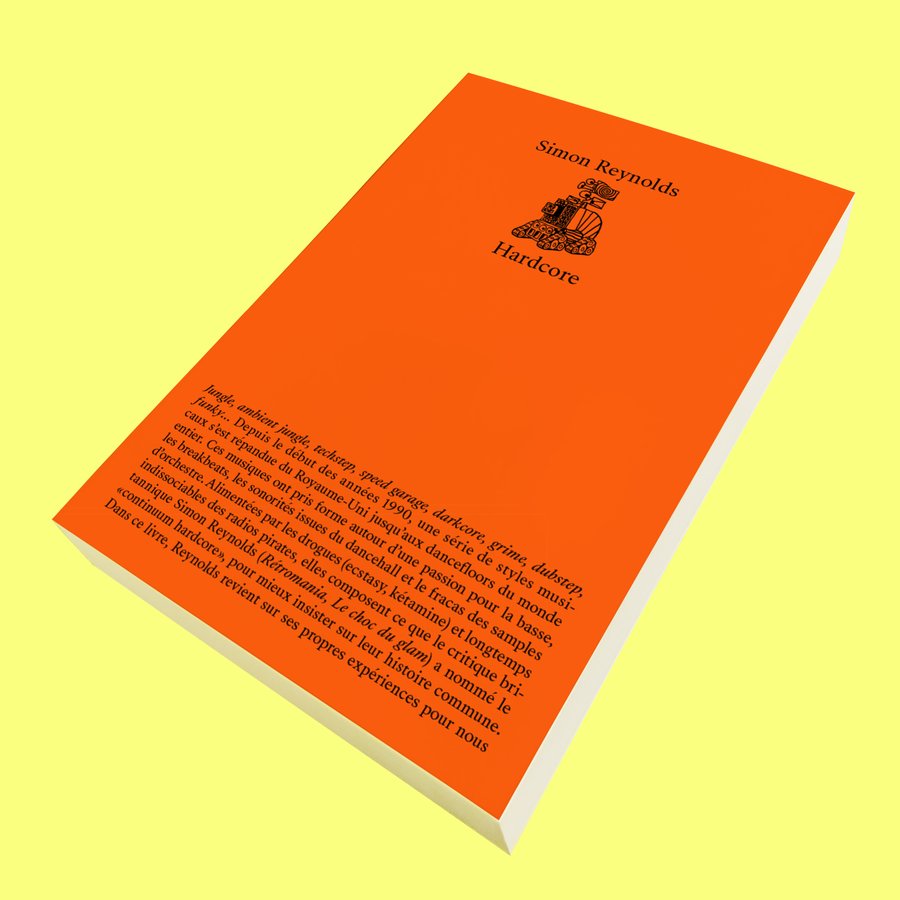
Break out your Harraps French-English Dictionaries - unless of course you are Francophone already - in readiness for the release in a week or so of Hardcore, a collation of my writings on the hardcore continuum, published exquisitely by Audimat Editions and translated by the fearless Jean-François Caro.

(Ha, I just realised that if you say "Hardcore" in French, it sounds phonetically as ardkore - my preferred demotic rendering). 

Below is the release rationale, en Français: 

Jungle, ambient jungle, techstep, speed garage, darkcore, grime, dubstep, funky… Depuis le début des années 1990, une série de styles musicaux s’est répandue du Royaume-Uni jusqu’aux dancefloors du monde entier. Ces musiques électroniques ont pris forme autour d’une passion pour la basse, les breakbeats, les sonorités issues du dancehall et le fracas des samples d’orchestre. Alimentées par les drogues (ecstasy, kétamine) et longtemps indissociables des radios pirates, elles composent ce que le critique britannique Simon Reynolds (Rétromania, Le choc du glam) a nommé le « continuum hardcore », pour mieux insister sur leur histoire commune. Dans ce livre, Reynolds revient sur ses propres expériences pour nous faire (re)découvrir une foule de maxis et de morceaux légendaires ou oubliés. Il revendique leur radicalité contre le mépris de classe, écoute les rapports féminin/masculin se transformer au cœur des infrabasses, et les réinscrit dans les trajectoires de la diaspora anglo-jamaïcaine et le multiculturalisme anglais. Avec son écriture à haute intensité, entre essai et reportage, cette anthologie inédite constitue un hommage sensible à l’énergie de la rave ainsi qu’un manifeste en prise sur l’innovation et la catharsis des dancefloors, à l’heure où les sonorités hardcore reviennent exorciser l’« anxiété généralisée » d’un capitalisme passé en mode turbo.


Vous pouvez acheter le livre ici


                                                        "Massif de Londres!"


                                                 "Big up ta poitrine Georges Kelly!"


Thursday, November 07, 2019

November tour of Germany and Switzerland


I'm heading off on a tour of Germany and Switzerland to give talks about The Sex Revolts, the book about gender, rebellion and rock that I wrote with Joy Press back in 1995, which is now coming out on Ventil Verlag in a German translation  (by Jan-Niklas Jäger).  Most talks follow the format of a video-illustrated lecture + dialogue with a moderator + audience Q/A.

I'm also doing some non-Sex Revolts talks while I'm over there, including a video-illustrated talk about UK rave and the hardcore continuum as part of the Robert Johnson Theorie series of discussion events held by by the renowned club Robert Johnson in Offenbach am Main. That's on November 16th. The other two I'm not sure are open to the general public as they are part of conferences, but included here on the off-chance. 

Details about those + the  Robert Johnson Nuum event are below this schedule for Sex Revolts events. 


SEX REVOLTS 

Berlin - Sunday, November 10th

Acud Macht Neu - 19.00


Nürnberg  - Monday,  November 11
DESI Stadtteilzentrum e.V. - Doors 19:30 / Start 20:00
Brückenstraße 23
90419 Nürnberg
with Bettina Wagegg and Jan-Niklas Jäger


Mannheim  - Tuesday, November 12
Port25 –Raum für Gegenwartskunst Hafenstr - 20 h
25-27 68159 Mannheim

with Julia Alicka and Matthias Rauch


Zürich - Wednesday, November 13

Photobastei  - 19 hr book signing / 20 hr talk
Sihlquai 125, 8005 Zürich

With Shantala Hummler

https://www.facebook.com/events/870210276713165/


Bern - Thursday, November 14

Kunsthalle Bern, Helvetiaplatz 1, 3005 Bern - 19.00

With Shantala Hummler


Köln - Friday, November 15
King Georg, Sudermansraße - 20.00
With Wolfgang Frömberg


Offenbach am Main  -Sunday, November 17

Hochschule für Gestaltung Offenbach - 18.00
Schlossstraße 31, 63065


Paderborn - Monday, November 18

Paderborn University - 17:00 Uhr
Warburger Str. 100, 33098 Paderborn
Room H1.232 (Tower H, Floor 1, Room 1.232.

with Prof. Dr. Christoph Jacke


Bochum - Tuesday, November 19

Oval Office Bar,  Schauspielhaus Bochum - - 19.00


Münster  - Wednesday, November 20th

Spec Ops - 8pm

Von-Vincke-Straße 5
48143 Münster

With Anna Seidel


OTHER EVENTS 


Hamburg - Saturday, November 9

UNERHÖRTMusikfilm Festival

Talk about rock documentaries, rock biopics, and the cinematic industry of nostalgia,  and dialogue with Prof. Dr. Christoph Jacke

Katholische Akademie - 2:30 p.m


Offenbach am Main  - Saturday, November 16th

Robert Johnson Theorie – a video-illustrated talk about UK rave and the hardcore continuum
Robert Johnson, Nordring 131, Offenbach am Main

21:45 Doors Open - 22:00 Start Lecture

https://www.facebook.com/events/463963911130226/


Hamburg - Thursday, November 21th

Hamburg (Insecurity) Sessions conference – a talk about “the slow cancellation of the future” and music in an atemporal era

Terrace Hill  
Feldstr. 66/5. Stock, 20359 Hamburg

19.00 doors open / 19.30 talk / 20.00–20.30 discussion with Michael Rother, Daniel Miller, Diane Zillmer. 


Sunday, April 29, 2012

nuum / post-nuum / anti-nuum


1/ "End of the Road"

probing piece by Martin Clark for FACT on road rap and its implications for the (uncertain-looking) future of the hardcore continuum

"Pirate radio is being replaced with a primary medium that is indistinguishable from media used by all other musical continuums, road rap is absorbing grime’s road energy into hip-hop’s traditions, house continues to satisfy ravers’ need to dance without a strong sense of local identity, breakbeat/bass science rudeness or flava. Grime and UK funky continue to iterate in interesting ways, ways that show real promise but can’t claim the seismic bursts of intense energy they once saw. Dubstep fans who reject brostep have dispersed into either purist halfstep traditionalist stasis (“the dungeon sound”), floating islands of the post-dubstep archipelago, trad European house  and techno, homogenizing crate-digging revivalism and eclecticism, US trap rap and juke. So what’s next?"

2/ same old scene-not-scene


"What all three tracks share in common is a profound, almost militant, resistance to the immediate, booming gratification that the vast majority of contemporary club music promises. Turning bass-music formulae inside out, they represent the anti-drop. But here's the other thing: these tunes are so extreme, in their own ways, that they don't exactly invite imitation. They're difficult and hermetic; they don't play well with others"--Philip Sherburne, fromThe Genre That Shall Not Be Named (Dubstep)
 
Surprised to to see Phil,  hitherto a comrade in neologistic arms, taking the naming = restriction stance here


of course what he's talking about does have a name,  an unsatisfactory placeholder name: postdubstep

nu-IDM is what I used to call it for a while and i couldn't help flashing on that in this description:


"Objekt's "Cactus"... was the first to catch my ear with a weird inversion of dance-music energies: its bass wobbles with the ferocity of the down-and-dirtiest dubstep, but the rest of the tune feels gutted and hollowed-out.The drum track seems to be missing information, as though a mute button had been pressed or a patch cable had come unplugged; for all its heaviness, it's a weirdly enervated tune, gliding listlessly like a sailboat stuck in the doldrums. I've never heard it in a club, and I can only imagine that it would be tough to play effectively"


[great youtube comment on this: "it's like someone put 1995 through a paper shredder" !!]

Phil pinpoints what may well be the most interesting and revealing characteristic of these hybrids, which is that they are one-offs...

 "Jabbed like iron rods into the clockwork of the night, they feel less like seeds for potential subgenres and more like weed killer, burning off the overgrowth."

hybridisation, in the era when analogue mediation still dominated, seemed to take the form of, well,  forms...  new forms... these became the focus, the centripetal attractor, for  a collective surge, a swarming...   scenius logic: a strong new template  off which myriad minor variations could be "seeded" (to use Phil's organicist metaphor)...  this then created a monolithic vibe (Amentalism... Wobblism being the last of these -isms?) that was both impressively/oppressively total at any given rave or club night...  but that also had staying power (a new template like breakbeat science, or bass-science, could last five or six years before all the potential permutations got played out)

hybridisation, in the post-broadband era (which quickly led to the not-quite-total-but-near-enough eclipse of analogue mediation) seems to rarely lead to anything.... anything much.   Hence the the one-off hybrids.... they are non-generative, non-genre-ative....  instead, there's an interminable series of momentary agglomerations...  a particular collation of networked influences mesh inside a producer's digital audio software...

offering further thoughts on this zone and "the anti-drop" Rory Gibb at Quietus notes how "these very UK-sounding hybrid forms don't exist in a vacuum. They're all held suspended by a tangled web of reference points, connections and affiliations. More so than, say, many early dubstep and grime producers [i.e. early 2000s, before broadband really seriously eclipsed the analogue channels-- hard to remember, but emergent/golden-age grime barely had any web presence], many of these producers have a deep knowledge of music stretching far beyond their immediate surrounds."

the more connectivity in the post-geographical sense (and atemporal, archive-raiding sense), the less connection to a here-and-now....  the more that artists are drawn out of a fully current, geographically-situated musical conversation... (a continuum)

as well as undermining the conditions for scenius to emerge, this centripetal, dis-integrative logic (inherent to digiculture, to networks?) seems to extend the other direction too... to worm itself inside the practice of the individual producer...  conceivably, it's as anti-genius as it is anti-scenius

for, at the extreme, even the artist doesn't develop a personal style... doesn't repeat themselves... each new track is another genre-of-one

style is related to a measure of inflexibility, a measure of predictability...  that's how we recognise artistic signature.... but in the ultra-flexibilized conditions of digiflux, the artist is encouraged to endlessly differ from himself or herself, is pulled every-which-way by the same forces that (as described in Martin Blackdown's piece) are dis-integrating the nuum

genre = collectivised style... it too depends on an element of inflexibility, an element of predictability... on lockstep


3/ oh those analogue days, those economy-of-scarcity days


FACT interview with Loefah on his attachment to vinyl and buying old hardcore and jungle 12s

Q:  So hardcore was the real beginning for you.

A:  Hardcore was what got me started buying music on vinyl, yeah. And it was literally ‘cos you couldn’t get it anywhere else. I didn’t have decks at the time, I couldn’t mix; I was like 11 or 12 years old. But I used to save my pound lunch money every day, ‘cos the records were a fiver, and on Fridays I’d go down to Wax City Records in Croydon..... At the same time I was picking up flyers and it was like the same thing with that, I started collecting flyers and just….being part of it. Being part of that hardcore thing...  It was all about, if you’ve got it, then you were hardcore [laughs]. What I try to do at the moment [with Swamp81] – it’s a similar kind of ethos. The music’s there on vinyl. If you want to go and get it, you can; I’m not gonna shout about it, I’m not gonna try to get it into HMV or whatever the fuck the high street record store is now [laughs], I’m not gonna go digital, I’m not gonna do all that shit… so it’s like, it’s over here. If you want to be part of it, you can be, but you’ve got to make a bit of effort. And that’s kind of what hardcore was about. If you made the effort to find your local independent record shop, if you made the effort to get the flyer to go to the rave – ‘cos without the flyer you literally wouldn’t know about it, there was no internet, there weren’t many adverts, at least not for the smaller raves – then you were hardcore. If you did make that effort, then you were accepted, you were in a kind of gang, a club. It was a special thing, and it was linked into the record shops, the vinyl, the pirates, the flyers – it was all this one thing together. That was hardcore for me.


Thursday, January 29, 2004

The Name Game

Well, if it’s not going to be Grime, I’d almost prefer Eski. At least it sounds new and strange. So what if it’s totally bound to that one-man-genre Wiley--there’s precedents for a brandname becoming the preeminent term for a whole genus--look at the way people in the UK say “I’m going to Hoover the carpet” even if the vacuum cleaner they’re using’s a different make.

As for “garage”, well why not take the anti-neologistic stance even further? How about “hardcore” for real continuum continuity. Or ‘Nuum Beat. (Only kidding).

(Angus's point about “garage” preserving the nonexistent link between Larry Levan and Wiley is cute but.… well you know there is a scene and a sound at stake here you know!)

At the end of the day, it doesn’t really matter what any of us decide to call it or not-call it-- the scene will decide. Wish it would hurry up.

That to me is the most intriguing thing: the failure of the scene to come up with its own genre term. It doesn’t seem a particularly encouraging sign.

The semantic vacillation and indeterminacy is actually hurting the scene, holding it back, I think. Genre names, when spontaneously generated from within a scene as the condensation of popular desire, have a powerful centripetal force. You can track a genre coming through (the shift from jungle tekno in 92 to jungalistic hardcore in 93 to JUNGLE in 94) and feel a subculture achieving a sense of its own identity and purpose. The name becomes a rallying cry, a recruiting tool. Names, well-chosen names, are semantic weapons for storming the barricades of the media, announcing yourself to the wider world. Loud and proud. We're here, get used to it.

The inability of the G**** scene to name itself suggests both a lack of will to power and, more worryingly, a lack of internal cohesion. It's like it's simultaneously withdrawn, insular, yet paradoxically fractured, fractious. A centrifugal tendency is at work that is really undermining its impact.

In terms of outside coverage, it’s quite comical the way newspaper pieces have to say “the music that is known variously as V W X Y Z” or “no one’ s quite decided the name for this new genre yet but…”. In his Dizzee piece in the New York Times, Kelefa Sanneh listed about six synonyms for Diz’s scene (including “gutter garage”, which never had any real currency outside my head! Well good to know who one of Blissblog's readers is anyway).

In terms of G****’s internal politics, the non-consensus over a name seems to reflect its excessively Balkanized crew-against-crew territoriality. That’s got to have some relationship with the poor sales of the music. The whole dubplates/specials thing, that JA sound system-descended strategy of keeping your own music tightly to your collective chest so that punters have to go to the dance if they want to hear it AT ALL (or tune into that specific pirate, even that specific crew show)…. it’s been taken way too far. The dubplate thing, once so exciting, has now ventured along its own axis right into a Zone of Fruitless Intensification. Even a lot of people in London must feel: if you're going to make it that hard to get hold of your music, I’m not going to bother. Presumably most people just tape it off the pirates and then by the time the vinyl’s come out a small aeon later, they can’t be bothered, they’ve moved onto to something else. That's if it ever comes out at all. Hence the syndrome Matt noted, where sales of 1000 are astronomical, the cue for incredulity. Shit, I can remember when Deep Blue's “Helicopter Tune” sounds 22 thousand, when a medium-level jungle tune sold 5 or 6000.

The way it’s going, I can almost see G*** turning into something like the NZ noise scene, lathe-cut editions of 25. Except it’s actually easier to get hold of Dead C-type music in the rest of the world!

Following this train of thought has made me feel quite gloomy re. G***, Eski, whateverthafuckitwantstobecalled. Although people on the ground tell me that my 2step Revival/Reinvention fantasy is just that, a fantasy, I do think that some kind of swing the other way is inevitable--towards extroversion, groove, inviting people in, openheartedness. Only three year and a half years ago the 2step generation rule da nation. It owned UK pop music. Now it’s shunted itself into a skrewface corner, clutching its shrinking pie. If experience shows us anything, it’s that there’s some kind of Internal Pendulum inside the Pirate Continuum, whenever the music goes too far along one axis (into a Zone of Fruitless Intensification), it’ll swing back violently the other direction. It’s a sort of self-correcting device. G**** is on the edge of the ZFI, maybe already some distance into it, on multiple axes --clunky/cruddy-soundquality/non-danceable/words>music/testosterone/dark'n'moody -- and it’s easy to imagine it whizzing back the other into swing/deluxe-gloss/groovy/music>words/oestrogen/light'n'happy. The ‘Nuum’s dormant/latent House genes will surely reactivate.