Showing posts with label SOUNDTRACKS. Show all posts

Thursday, May 05, 2022

Bob 'n' Barry

Bob Stanley has a new book just out (Let's Do It - about the prehistory of pop, it looks really interesting). But he also has a new compilation out - or perhaps I should say collection, as it's focused on a single artist: John Barry. The More Things Change: Film, TV & Studio Work 1968-1972 is a great-sounding slab of peak JB. 
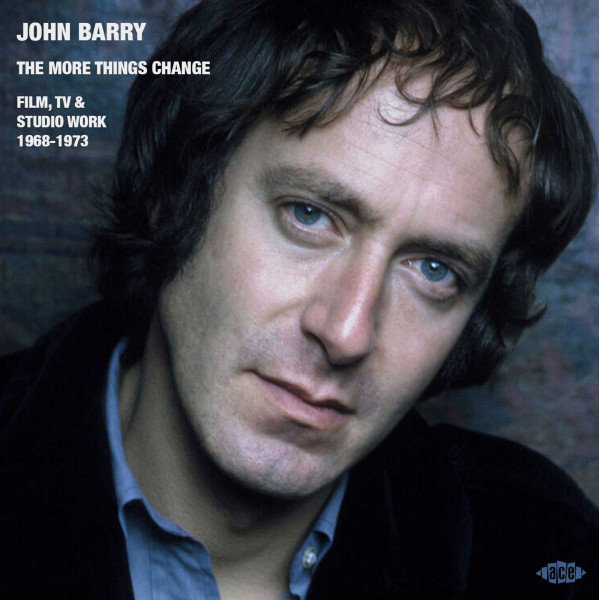


Reading Bob's liner note, I was fascinated to learn that the teenage Barry's love of soundtracks was ignited through his dad's being the owner of a chain of cinemas. He'd sit in the projection room of the York Rialto, assimilating the emotional grammar of film music through exposure to scores and scores of scores. 

Another thing that caught my eye was Bob's reference to Walkabout as "possibly the most beautiful John Barry score of all."   Now this happens to be my fervent belief, but it's a conviction based mostly on pure faith, since I've not done the exhaustive study of  the JB uuurv that Bob's done. So that was reassuring! 

The More Things Change includes two selections from the Walkabout OST (mystifyingly never released at the time, it existed briefly as a bootleg some years after the event, then came out as proper reissue in 2016) and they are "Theme from Walkabout," a shatteringly poignant piece that can reduce me to a blubbering mess, and "The Children", stirring and pure-hearted.   Here's what I wrote about Walkabout for Pitchfork's best soundtracks / best scores lists of a few years ago: 

In Nicolas Roeg’s 1971 film, two British children stranded in the outback are rescued and guided back to “civilization”  by an indigenous Australian boy. Scare quotes around the C-word, for Walkabout is a rhapsodic elegy for Nature and our lost innocence.  Because there’s only sporadic dialogue (Roeg described the script as “a fourteen-page prose poem”) and the 6-year-old brother and his teenage sister have been brought up in typically post-Empire stiff-upper-lip fashion, nearly all the emotional eloquence in the movie is supplied by the score.  Waltjinju Bandilil’s eerie didgeridoo and Stockhausen’s disorienting tape-piece Hymnen conjure the unknowable majesty of the arid landscape and its scorching extremes of weather. But it’s veteran film composer John Barry who establishes the prevailing mood with his piercingly poignant orchestrations.   A stirring choral theme redolent of a school song, “The Children” evokes the simple-hearted hope and accepting obedience with which kids face the world. The horn fanfares of  “The Journey”  conjure a storybook adventure air, mirroring the way that the youngest child in particular processes their predicament.  Above all, there’s the recurring main theme, a patient pulse of plinky harpsichord over which wistful woodwinds pipe and tender violins soar and swoop, like a kite whose strings are tugging at your heart not your hands.


Here are the other blurbs - in their original director's cut form - that I did for the movies Performance, Solaris, Blade Runner, and McCabe & Mrs. Miller. 


Tuesday, January 19, 2021

soundtrackism - Acen + Eno

In the new issue of The Wire, I have a big review of Trip to the Moon 2092, a six-disc vinyl expansion of the Acen classic "Trip II the Moon" - widely considered the greatest hardcore rave anthem ever, and  originally released through the summer of 1992 in three successive versions, each more tempestuous and grandiloquent than the last. The 2092 box set is out any day now on Kniteforce Revolution. In addition to the print-magazine-only review, at The Wire website there is an interview with Acen Razvi. He gave me the lowdown on his journey from breakdancing on a sheet of lino in West London to building breakbeat symphonies for Willesden label Production House and talked about his love of film soundtracks (John Barry's Bond music and Ennio Morricone's "Chi Mai" being key sample sources for "Trip" and the killer B-side "Life and Crimes of a Ruffneck"). 

Talking of the movies...  the winter 2020-2021 issue of Sight & Sound features my interview with Brian Eno about his career-long involvement in making music for film and TV, the influence soundtracks and scores have had on his ideas about sound, and what he's been watching during the pandemic. The piece is pegged to his new compilation Film Music 1976-2020.  It was a real delight chatting with Mr. Eno  - I can't remember the last time I laughed so much in an interview. 


              the other electrifying sample in "Trip II the Moon" - electrocuted diva Maureen Mason - here sounds freakily mellow in the original Tongue N Cheek Britsoul fave


                  look for the shadowy rave magus Acen amidst the amazing dancing twins (not actually twins apparently)


The "River Deep, Mountain High" of rave is how I described  this mix of "Windows" here once 


More box sets from Kniteforce coming this year I'm told, including one for this track, Acen's debut


Thursday, February 21, 2019

you know the score

I really enjoyed contributing to the Pitchfork lists of The 50 Best Movie Scores of All Time and  The 50 Best Movie Soundtracks of All Time. The original plan was for a single unified list but there were so many suggestions from the electorate that it got split into two, although the distinction between score and soundtrack can get blurry with some films having a mixture of all-new and preexisting musical elements.

For Scores, I wrote about Blade Runner, Walkabout, and Solaris.

For Soundtracks, I wrote about Performance and McCabe & Mrs. Miller.

In these lists, there are lots of films with great scores and soundtracks I'd forgotten about, and  many that I didn't know at all -  loads here to investigate and read about.

Quite a few of the ones I voted for didn't make the cut - below are some faves that did not get ratified by the electorate.


BEDAZZLED – Dudley Moore
As well as starring as the hapless Stanley Moon, who sells his soul to the devil for seven wishes, Dudley Moore -  being a jazz pianist, songwriter and arranger of considerable talent -  wrote the score to this Sixties Brit caper, variations on a theme that are rendered by turns insouciant, idyllic, poignant, and snazzy. There’s also a pair of brilliant Sixties pop parodies: “Love Me” (performed by Moore with moist passion) and “Bedazzled”, on which Peter Cook deadpans his disdain and indifference to all amorous advances - ‘you fill me with INERTIA”.

RIP Stanley Donen, the director.


FORBIDDEN PLANET – Louis and Bebe Barron
For one of the superior science fiction movies of the 1950s, this husband and wife team created the first entirely electronic score in movie history: an abstract, virtually atonal sequence of drones, shrieks, groans and pulsations that seem to reverberate from the coldest, blackest recesses of deep space. But because the Barrons were credited ambiguously with "electronic tonalities", they were cheated of a chance to contend for an Oscar for Best Soundtrack.


THE ANDROMEDA STRAIN – Gil Melle
A sci-fi thriller about scientists investigating a lethal super-virus of extraterrestrial origin in an isolated white-walled underground laboratory gets an appropriately chilly and sterile-sounding score from jazzer turned instrument-inventor. Melle used found industrial sounds like jet propulsion lab blasts and roars and  transformed them by tape-editing. 


ESCAPE FROM NEW YORK  - John Carpenter
One of the director/composer's best, ranging from bloodcurdling, borderline-abstract sequences like "The Crazies Come Out" to more melodic synth-pulse propelled tunes like "Orientation #2," which glides along like an empty monorail car coldly surveying the ravaged city below.


BEYOND THE VALLEY OF THE DOLLS – Stu Philips & Bob Stone, et al

Russ Meyer’s mischievously over-the-top camp satire of the rock biz and Los Angeles decadence gets an equally ersatz superb set of songs. Performed in the movie by the fictitious all-girl group The Carrie Nations, the vocals actually came from the off-screen session singer Lynn Carey, a blue-eyed soul powerhouse. There’s also contributions by “real” psych pop group Strawberry Alarm Clock and a kitschy theme song by The Sandpipers,


LOGAN’S RUN – Jerry Goldsmith
Partly orchestral, partly synth, the veteran movie composer’s O/S/T is particularly stunning on the icy electronica of “Flameout” and “Fatal Games” and the pulsating pornodelia of  "Love Shop," which scores a sequence in which the hero and heroine's escape through a strobe-blitzed brothel of the future.


THE LONG GOOD FRIDAY – Francis Monkman
Formerly of prog rock group Curved Air, Monkman whips together an unexpectedly jazzy and funky OST for this Brit gangland thriller – at its most strutting and flamboyant on the main theme, which bookends the movie and accompanies the abrupt downfall of Bob Hoskins’s East London mobster to make for one of cinema’s most exhilarating outro sequences.


THX 1138  - OST by Lalo Schifrin; “sound montages” by Walter Murch
Schifrin’s orchestral score for George Lucas’s dystopian movie is somber and impressive in its own right. But what really makes THX such a compellingly total audio-visual experience are Murch’s sound design, effects and underscores: sourceless shudders and judders, abject squelches, android death-rattles, shearing-metal groans, and, not least,  the electronic garbling and distortion applied to the voices of the bureaucrats who surveil every citizen constantly.


Here's some other faves that did not get the nod.

Stalker
The Great Rock 'n' Roll Swindle
Rosemary’s Baby
Liquid Sky
Dark Star
Zardoz
Barbarella
Klute 
Gregory’s Girl
The Draughtsman's Contract
The Parallax View


And these are ones I voted for that did get ratified 

Under the Skin
Dazed and Confused
The Good the Bad and the Ugly
Taxi Driver
2001, A Space Odyssey
The Wicker Man
Suspiria
Midnight Cowboy