Showing posts with label HARDCORE CONTINUUM. Show all posts

Friday, August 19, 2022

le hardcore ne mourra jamais


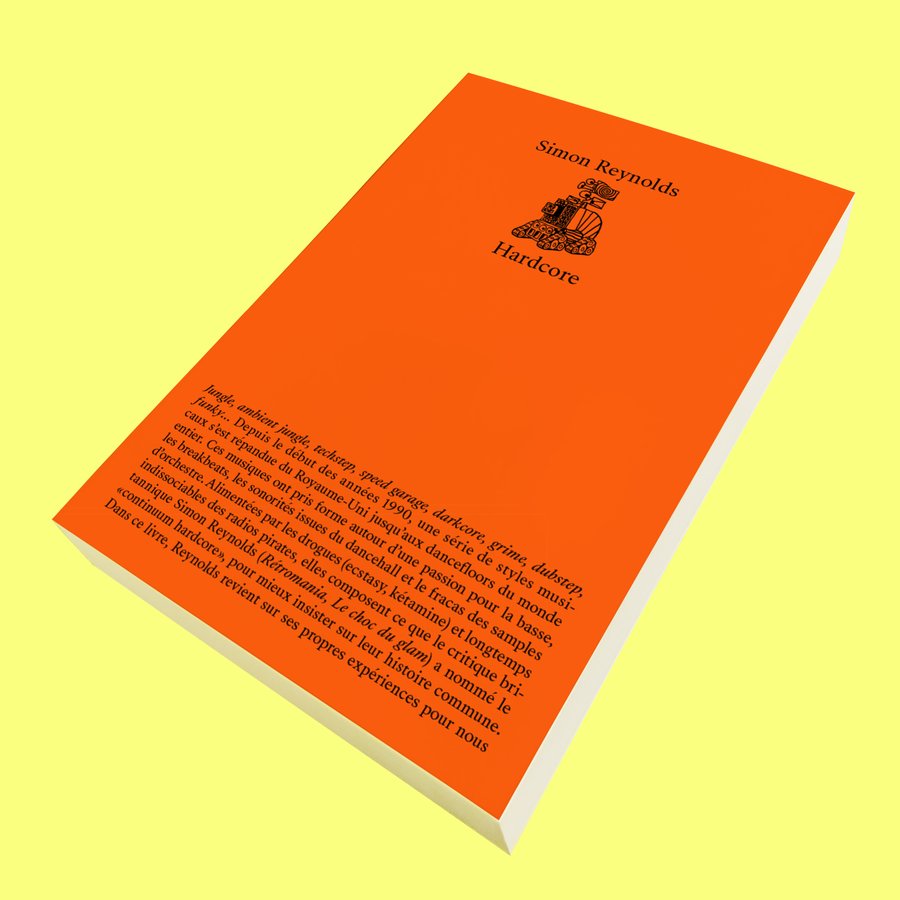
Break out your Harraps French-English Dictionaries - unless of course you are Francophone already - in readiness for the release in a week or so of Hardcore, a collation of my writings on the hardcore continuum, published exquisitely by Audimat Editions and translated by the fearless Jean-François Caro.

(Ha, I just realised that if you say "Hardcore" in French, it sounds phonetically as ardkore - my preferred demotic rendering). 

Below is the release rationale, en Français: 

Jungle, ambient jungle, techstep, speed garage, darkcore, grime, dubstep, funky… Depuis le début des années 1990, une série de styles musicaux s’est répandue du Royaume-Uni jusqu’aux dancefloors du monde entier. Ces musiques électroniques ont pris forme autour d’une passion pour la basse, les breakbeats, les sonorités issues du dancehall et le fracas des samples d’orchestre. Alimentées par les drogues (ecstasy, kétamine) et longtemps indissociables des radios pirates, elles composent ce que le critique britannique Simon Reynolds (Rétromania, Le choc du glam) a nommé le « continuum hardcore », pour mieux insister sur leur histoire commune. Dans ce livre, Reynolds revient sur ses propres expériences pour nous faire (re)découvrir une foule de maxis et de morceaux légendaires ou oubliés. Il revendique leur radicalité contre le mépris de classe, écoute les rapports féminin/masculin se transformer au cœur des infrabasses, et les réinscrit dans les trajectoires de la diaspora anglo-jamaïcaine et le multiculturalisme anglais. Avec son écriture à haute intensité, entre essai et reportage, cette anthologie inédite constitue un hommage sensible à l’énergie de la rave ainsi qu’un manifeste en prise sur l’innovation et la catharsis des dancefloors, à l’heure où les sonorités hardcore reviennent exorciser l’« anxiété généralisée » d’un capitalisme passé en mode turbo.


Vous pouvez acheter le livre ici


                                                        "Massif de Londres!"


                                                 "Big up ta poitrine Georges Kelly!"


Sunday, August 07, 2022

!! Pause for the Cause: London Rave Adverts 1991-1996 Vol 2 !!


Luke Owen of Death Is Not The End has swiftly followed up Pause for the Cause: London Rave Adverts 1991-1996 Vol. 1.  with Pause for the Cause: London Rave Adverts 1991-1996 Vol. 2 - another bumper collection of pirate ads from back in the rave days, including some more audio contributions from me. And here's the blurb I came up with: 

 "Back in the early ‘90s, whenever the pirate radio MC announced “a pause for the cause”, I usually pressed pause on my cassette recorder. That’s something I would regret years later, when ad breaks had become cherished mementos of the hardcore rave era. Luckily, back in the day I often left the tape running while I went off to do something else. So a fair number of ad breaks got captured accidentally for my later delectation. Not nearly enough, though. So in recent years I started combing through the immense number of pirate radio sets archived on the internet.  Sometimes the tracklists would note “ad break” or “ads”, helping to narrow the search. But often I’d just stumble on a bunch in the middle of a pirate show preserved on YouTube or an old skool blog.  A few of my original unintended “saves” and latterday “finds” are included in this wonderful collection by audio archaeologist Luke Owen. It’s the latest in his series of compilations of UK pirate radio advertisements, with this volume focusing on the audio equivalent of the rave flyer: MCs breathlessly hyping a club night or upcoming rave, listing the lineup of deejays and MCs, boasting about hi-tech attractions like lasers and projections, mentioning prices and nearest landmarks to the venue, and occasionally promising “clean toilets” and “tight but polite security” (“sensible security” is another variation). Some of these ads are etched into my brain as lividly as the classic hardcore and jungle tunes of that time. (Most rave ads incorporate snippets of current music, of course – big anthems and obscure “mystery tracks” alike).   Names of deejays ring out like mythological figures: who were Shaggy & Breeze, Kieran the Herbalist, Tinrib, Food Junkie?  Putting on my serious hat for a moment, I think these ads are valuable deposits of sociocultural data, capturing the hustling energy of an underground micro-economy in which promoters, deejays and MCs competed for a larger slice of the raving audience.   But mostly, they are hard hits of pure nostalgic pleasure, amusing and thrilling through their blend of period charm, endearing amateurism,  and contagiously manic excitement about rave music’s forward-surge into an unknown future. The best of these ads give me a memory-rush to rival the top tunes and MC routines of the era."    

You can hear and buy Pause for the Cause Vol. 2 digitally and as a limited-edition cassette at Bandcamp. 


One of my contributions to Pause for the Cause #2. 

Here's my Guardian piece from last year on the first two collections of UK pirate radio adverts that Death Is Not The End put out. 

And here's a longer interview I did with Luke about his label and the interest in pirate radio transmissions.

Since then Death Is Not The End has out a collection of a different era of pirate radio - Brooklyn Pirates: Neighbourhoods in the Sky, 2014-2021 - compiled by David Goren, an audio archivist based in Brooklyn. 


Friday, July 08, 2022

Pause for the Cause: London Rave Adverts 1991-1996 Vol. 1


Luke Owen of Death Is Not The End has just today released a new volume in his compilation series collecting pirate radio ads from the '90s. Here's my blurb for Pause for the Cause: London Rave Adverts 1991-1996 Vol. 1.

 "Back in the early ‘90s, whenever the pirate radio MC announced “a pause for the cause”, I usually pressed pause on my cassette recorder. That’s something I would regret years later, when ad breaks had become cherished mementos of the hardcore rave era. Luckily, back in the day I often left the tape running while I went off to do something else. So a fair number of ad breaks got captured accidentally for my later delectation. Not nearly enough, though. So in recent years I started combing through the immense number of pirate radio sets archived on the internet.  Sometimes the tracklists would note “ad break” or “ads”, helping to narrow the search. But often I’d just stumble on a bunch in the middle of a pirate show preserved on YouTube or an old skool blog.  A few of my original unintended “saves” and latterday “finds” are included in this wonderful collection by audio archaeologist Luke Owen. It’s the latest in his series of compilations of UK pirate radio advertisements, with this volume focusing on the audio equivalent of the rave flyer: MCs breathlessly hyping a club night or upcoming rave, listing the lineup of deejays and MCs, boasting about hi-tech attractions like lasers and projections, mentioning prices and nearest landmarks to the venue, and occasionally promising “clean toilets” and “tight but polite security” (“sensible security” is another variation). Some of these ads are etched into my brain as lividly as the classic hardcore and jungle tunes of that time. (Most rave ads incorporate snippets of current music, of course – big anthems and obscure “mystery tracks” alike).   Names of deejays ring out like mythological figures: who were Shaggy & Breeze, Kieran the Herbalist, Tinrib, Food Junkie?  Putting on my serious hat for a moment, I think these ads are valuable deposits of sociocultural data, capturing the hustling energy of an underground micro-economy in which promoters, deejays and MCs competed for a larger slice of the raving audience.   But mostly, they are hard hits of pure nostalgic pleasure, amusing and thrilling through their blend of period charm, endearing amateurism,  and contagiously manic excitement about rave music’s forward-surge into an unknown future. The best of these ads give me a memory-rush to rival the top tunes and MC routines of the era."    

Here hear -  and buy - Pause for the Cause, which is available digitally and as a limited-edition cassette. 

Death Is Not The End has a regular NTS Radio show and this Sunday Luke will be playing a batch of radio ads not on the new compilation (including a few more of mine). It broadcasts at 8pm GMT on Sunday 10 July, then will be available on the archive via this link sometime early next week.


One of my contributions to Pause for the Cause. 

Here's my Guardian piece from last year on the first two collections of UK pirate radio adverts that Death Is Not The End put out. 

And here's a longer interview I did with Luke about his label and the interest in pirate radio transmissions.

Since then Death Is Not The End has out a collection of a different era of pirate radio - Brooklyn Pirates: Neighbourhoods in the Sky, 2014-2021 - compiled by David Goren, an audio archivist based in Brooklyn. 


Tuesday, February 16, 2021

we'll be back after the ads

Observant readers of these blogs may have noticed my burgeoning interest in the adverts that punctuated the shows on hardcore jungle pirate radio stations. I've been combing through my own tapes (cursing the preponderance of recordings where I pressed pause when the ad break started) and  trawling through sets that are online. The best adverts are distilled slivers of vibe and scene-character, and contain genuine sociohistorical interest. But mostly their nutty nonsense and DIY charm gives me a delicious memory-rush. 

So I was well chuffed to come across a fellow obsessive in Luke Owen, the man behind the archival audio label Death Is Not The End. In the last month or so, Luke has put out London Pirate Radio Adverts, 1984-1993 Vol. 1 and the just-released London Pirate Radio Adverts, 1984-1993 Vol. 2 - both of which are available digitally at a name-your-price rate and for a modest amount as a limited-edition cassette or in CD form. 

Here is my piece for The Guardian  on the compilations, featuring quotes from Luke,  pirate radio historian Stephen Hebditch, and DJ/producer Nick Power who played on Pulse FM and other pirates, and who made one of my favorite ads for his own record store Music Power Records (it can be found on the Vol. 1 compilation).


In a week or so I'll run the full chat with Luke about his project, which I hope will continue. 

And do check out Luke's earlier collection from last year of sound snippets from the Bristol pirate radioscape of the late 90s. 

Three of my favorite pirate ads. 


The chap who voiced those Telepathy ads (there's a whole series of them running through the entire era) was called Sting and he was the founder of Club Telepathy and also owner-operator of Deja Vu FM. 

Back to Nick Power - as a producer, with DJ Ku - who worked as an assistant in Music Power Records -  he made these little beauties 


His label Ruff Tuff  & Wicked Stuff also put this minor classic out:


And this little piss-taker


In addition to his DJing and retail mini-empire (two records shops and store selling disco and sound system equipment), Power - being of Greek-Cypriot background - also pioneered clubbing in Ayia Napa, long before it became a UK Garage destination. 


Wednesday, March 14, 2018

frozen futures and final sicknesses (see you in 2018)


On news stands now, the latest issue of  The Wire contains a long review by me pairing the comeback album by Marc Acardipane a/k.a The Mover with  Sick Music 2018, a compilation of contemporary drum + bass on the Hospital label that I surprised myself by enjoying much more than I'd expected.  As well as an enthused review of two fine records, the piece is an investigation of  the fate of vanguard genres (in this case, gloomcore gabba and D+B) when their accelerationist drive stabilises into a steady state.


The Mover - Undetected Act from the Gloom Chamber.

Also in the April issue, a reet treet for all nuumologists: Michaelangelo Matos's Primer to Pirate Radio Deejay Sets. He's done a fine job laying out the evolution from circa 1989 through to the post-dubstep diaspora and his forensic sifting through the messy mass of archival tapes deposited online by old skool fans has uncovered a trove of true gems. This is probably my favorite of the Matos selections that I've so far checked out.


Finally, in case you missed it, I recently uploaded the best of my own stash of pirate tapes, which I'd digitized some years ago but never got around to turning into YouTube clips.

Thursday, October 26, 2017

Spectres of Mark: The State of the Debt, the Work of Mourning

Here's an essay I did for Pitchfork about Burial's Untrue ten years on. 

It's also effectively a tribute to Mark Fisher, who is a recurring presence in the piece. 


It's intentional that Burial's real name is never once mentioned in the piece - honoring his original allegiance to rave's radical facelessness and anonymous collectivity. 


Below is my favorite out of the post-Untrue Burial output - in some ways the missing chapter from that album.


There were two parallels and precursors for Burial's  ghost-of-rave (as ghost-of-socialism) aesthetic that I couldn't get into as it would have been too much of a digression.


The first: Mark Leckey's Fiorucci Made Me Hardcore, which I wrote about here. 


And the second:  "Weak Become Heroes" by The Streets.


What Burial related through samples and moody orchestrations, Mike Skinner conveyed with words,  describing the flashback of a former raver abruptly set adrift on blissed memories of love and unity on the dancefloor. “All the commotion becomes floating emotions...  They could settle wars with this...  Imagine the world's leaders on pills... All of Life's problems I just shake off.” Then he's snapped back to the dreary streets of a hostile and hopeless 21st Century England: “gray concrete and deadbeats... no surprises no treats... My life's been up and down since I walked from that crowd.” “Weak,” in Skinner’s song, means not just personally frail, but politically powerless. The weak became heroes when they became a mass, uniting around the unwritten manifesto in the music: someday there’ll be a better way, but in the meantime let’s shelter for a while in this dreamworld.  What the critic Richard Smith (like dear Mark also “late” now – so many ghosts these days) called “the communism of the emotions” triggered by Ecstasy seemed to prefigure a social movement. But the collective energy never got beyond the level of a pre-political potential; the moment dissipated. 


“I love those hardcore and rave tunes because they sound deep, hopeful, for the times, and the people... It’s unbelievable, that glow in the tunes, it almost breaks your heart.” - Burial, someplace, sometime


"The tunes I loved the most…old jungle, rave and hardcore, sounded hopeful....  All those lost producers…I love them, but it’s not a retro thing… When I listen to an old tune it doesn’t make me think ‘I’m looking back, listening to another era.’ Some of those tunes are sad because they sounded like the future back then and no one noticed. They still sound future to me." - Burial, someplace, sometime  

In a way, it's a shame Burial stopped doing the interviews -  he was almost born to do them, even more than make music! He's better at describing his own music and motives than any of his critics, except K-punk himself. I remember Mark telling me after he'd done the interview that he couldn't believe his own ears - the stuff that Burial was coming out with was so poetic and evocative, too good to be true almost. A dream of an interview. Anwen Crawford told me of a similar experience: as I recall it, it was like she was hypnotized, sent into a trance by his voice over the phone. But at same time he was completely real and genuine - somehow down to earth and an ethereal being floating out there at the same time....


"I wanted the tunes to be anti-bullying tunes that could maybe help someone to believe in themselves, to not be afraid, and to not give up, and to know that someone out there cares and is looking out for them. So it's like an angel's spell to protect them against the unkind people, the dark times, and the self-doubts" - Burial on Rival Dealer EP / "Come Down With Us"

^^^^^^^^^^^^

Actually there's a third parallel/precursor - The Death of Rave by V/Vm, a/k/a The Caretaker - another of Mark's favorites of course... 


This post is dedicated to Carl Neville. 

Monday, June 25, 2012


Dude spots a sound that nobody else (in this sphere) seems to have noticed yet!

Jackin House

As he (Musings of A Socialist Japanologist) concedes there is something a bit
"hyperstatic" /  recent-dance-history-in-shuffle-mode about this Northern mixture of electro house, bassline, speed garage, 2step, dubstep, funky...

but, as in the Grand Tradition, the prominence of MCs lifts it above less-than-the-sum-of-its-parts


lots of luvly nuumy features noted by MoaSJ:

"tracks with a bassline/dubstep wobble are called 'wobblers'"

"tracks using the Double 99/187 Lockdown Speed Garage bass warp are, fittingly, called 'warpers'."

and that hallmark: "the surfeit of cheeky pop tune bootlegs"

by which MoaSJ means current stuff I assume


although he also posts the video for this gorgeously etheralised versioning of a 30 year old R&B hit....


yes that's Chaka Khan's "Ain't Nobody"....

 I like this formulation: 

"For now, it might be fair to call Jackin one of the first Metamodernist dance scenes, neither straight forwardly postmodern/revivalist nor jetting off into a modernist future"

which MoaSJ parallels with a lyric from the Majestic track in this Marcus Nasty mix

"We can't go back,
That's in the past when I reminisce now 
Bring on the future, here for the day,
I'll be making music come what may.
I don't come from the Old Skool,
But I got to big up the Old Skool"


we can't go back but (equally) the past is more present to us, more ransackable, than ever -- hence the way that "Ain't Nobody' sits next to Drake sits next to  Peggy Lee's "Fever" sits next to Notorious BIG next to MIA next to "Fix Up Look Sharp' in the bootleggers arsenal

then again, "metamodernist" is kinda where the nuum has always been at, if you think about it -- metamodernist is a flava-free synonym for "roots and future"


if nothing else (c.f. New Jersey Club)  it's a new twist in the ouroboros

Sunday, April 29, 2012

nuum / post-nuum / anti-nuum


1/ "End of the Road"

probing piece by Martin Clark for FACT on road rap and its implications for the (uncertain-looking) future of the hardcore continuum

"Pirate radio is being replaced with a primary medium that is indistinguishable from media used by all other musical continuums, road rap is absorbing grime’s road energy into hip-hop’s traditions, house continues to satisfy ravers’ need to dance without a strong sense of local identity, breakbeat/bass science rudeness or flava. Grime and UK funky continue to iterate in interesting ways, ways that show real promise but can’t claim the seismic bursts of intense energy they once saw. Dubstep fans who reject brostep have dispersed into either purist halfstep traditionalist stasis (“the dungeon sound”), floating islands of the post-dubstep archipelago, trad European house  and techno, homogenizing crate-digging revivalism and eclecticism, US trap rap and juke. So what’s next?"

2/ same old scene-not-scene


"What all three tracks share in common is a profound, almost militant, resistance to the immediate, booming gratification that the vast majority of contemporary club music promises. Turning bass-music formulae inside out, they represent the anti-drop. But here's the other thing: these tunes are so extreme, in their own ways, that they don't exactly invite imitation. They're difficult and hermetic; they don't play well with others"--Philip Sherburne, fromThe Genre That Shall Not Be Named (Dubstep)
 
Surprised to to see Phil,  hitherto a comrade in neologistic arms, taking the naming = restriction stance here


of course what he's talking about does have a name,  an unsatisfactory placeholder name: postdubstep

nu-IDM is what I used to call it for a while and i couldn't help flashing on that in this description:


"Objekt's "Cactus"... was the first to catch my ear with a weird inversion of dance-music energies: its bass wobbles with the ferocity of the down-and-dirtiest dubstep, but the rest of the tune feels gutted and hollowed-out.The drum track seems to be missing information, as though a mute button had been pressed or a patch cable had come unplugged; for all its heaviness, it's a weirdly enervated tune, gliding listlessly like a sailboat stuck in the doldrums. I've never heard it in a club, and I can only imagine that it would be tough to play effectively"


[great youtube comment on this: "it's like someone put 1995 through a paper shredder" !!]

Phil pinpoints what may well be the most interesting and revealing characteristic of these hybrids, which is that they are one-offs...

 "Jabbed like iron rods into the clockwork of the night, they feel less like seeds for potential subgenres and more like weed killer, burning off the overgrowth."

hybridisation, in the era when analogue mediation still dominated, seemed to take the form of, well,  forms...  new forms... these became the focus, the centripetal attractor, for  a collective surge, a swarming...   scenius logic: a strong new template  off which myriad minor variations could be "seeded" (to use Phil's organicist metaphor)...  this then created a monolithic vibe (Amentalism... Wobblism being the last of these -isms?) that was both impressively/oppressively total at any given rave or club night...  but that also had staying power (a new template like breakbeat science, or bass-science, could last five or six years before all the potential permutations got played out)

hybridisation, in the post-broadband era (which quickly led to the not-quite-total-but-near-enough eclipse of analogue mediation) seems to rarely lead to anything.... anything much.   Hence the the one-off hybrids.... they are non-generative, non-genre-ative....  instead, there's an interminable series of momentary agglomerations...  a particular collation of networked influences mesh inside a producer's digital audio software...

offering further thoughts on this zone and "the anti-drop" Rory Gibb at Quietus notes how "these very UK-sounding hybrid forms don't exist in a vacuum. They're all held suspended by a tangled web of reference points, connections and affiliations. More so than, say, many early dubstep and grime producers [i.e. early 2000s, before broadband really seriously eclipsed the analogue channels-- hard to remember, but emergent/golden-age grime barely had any web presence], many of these producers have a deep knowledge of music stretching far beyond their immediate surrounds."

the more connectivity in the post-geographical sense (and atemporal, archive-raiding sense), the less connection to a here-and-now....  the more that artists are drawn out of a fully current, geographically-situated musical conversation... (a continuum)

as well as undermining the conditions for scenius to emerge, this centripetal, dis-integrative logic (inherent to digiculture, to networks?) seems to extend the other direction too... to worm itself inside the practice of the individual producer...  conceivably, it's as anti-genius as it is anti-scenius

for, at the extreme, even the artist doesn't develop a personal style... doesn't repeat themselves... each new track is another genre-of-one

style is related to a measure of inflexibility, a measure of predictability...  that's how we recognise artistic signature.... but in the ultra-flexibilized conditions of digiflux, the artist is encouraged to endlessly differ from himself or herself, is pulled every-which-way by the same forces that (as described in Martin Blackdown's piece) are dis-integrating the nuum

genre = collectivised style... it too depends on an element of inflexibility, an element of predictability... on lockstep


3/ oh those analogue days, those economy-of-scarcity days


FACT interview with Loefah on his attachment to vinyl and buying old hardcore and jungle 12s

Q:  So hardcore was the real beginning for you.

A:  Hardcore was what got me started buying music on vinyl, yeah. And it was literally ‘cos you couldn’t get it anywhere else. I didn’t have decks at the time, I couldn’t mix; I was like 11 or 12 years old. But I used to save my pound lunch money every day, ‘cos the records were a fiver, and on Fridays I’d go down to Wax City Records in Croydon..... At the same time I was picking up flyers and it was like the same thing with that, I started collecting flyers and just….being part of it. Being part of that hardcore thing...  It was all about, if you’ve got it, then you were hardcore [laughs]. What I try to do at the moment [with Swamp81] – it’s a similar kind of ethos. The music’s there on vinyl. If you want to go and get it, you can; I’m not gonna shout about it, I’m not gonna try to get it into HMV or whatever the fuck the high street record store is now [laughs], I’m not gonna go digital, I’m not gonna do all that shit… so it’s like, it’s over here. If you want to be part of it, you can be, but you’ve got to make a bit of effort. And that’s kind of what hardcore was about. If you made the effort to find your local independent record shop, if you made the effort to get the flyer to go to the rave – ‘cos without the flyer you literally wouldn’t know about it, there was no internet, there weren’t many adverts, at least not for the smaller raves – then you were hardcore. If you did make that effort, then you were accepted, you were in a kind of gang, a club. It was a special thing, and it was linked into the record shops, the vinyl, the pirates, the flyers – it was all this one thing together. That was hardcore for me.